Enterprise-Grade Security Management Platform · Standalone Vulnerability Management Edition Available

Zhaoxun Intelligent Security Management Platform

Turn multi-source vulnerability scan reports into an actionable ledger: reconcile on import, track every status transition with a full audit trail, leverage AI-assisted remediation, and close the loop with dashboard overviews and Excel round-trips. A standalone Vulnerability Management Edition is also available.

Product Overview

One Platform, Unifying Vulnerability Remediation and Security Compliance

The Zhaoxun Intelligent Security Management Platform is an enterprise-grade security platform developed in-house by Zhaoxun, designed around the real workflows of security operations teams. With vulnerability management as its core module, it consolidates reports scattered across various scanning tools into a unified ledger. It also supports delivery as a standalone Vulnerability Management Edition for customers who need only vulnerability ledger capabilities.

Four Functional Domains

  • Security Professional Services: Vulnerability management (import, analysis, reporting) and the security agent (conversational initiation, capability catalog, task console);
  • Security Compliance Services: Standards and project management across three business lines—MLPS (Multi-Level Protection Scheme), ISO, and Personal Information Protection (PIPL)—forming a closed-loop remediation workflow with vulnerability handling;
  • Basic Configuration: Customer, application, team, scanning tool, service, and project configuration, including Agent authorization and credential management;
  • Intelligent Knowledge Base: Document management and AI-driven conversations that capture and grow your team's security knowledge.

The platform's vulnerability management stack runs on the /vuln/* endpoints and vuln_record data model, while security agent APIs are unified under /security/agent/*. From report import, status transitions, and AI analysis to Excel round-tripping, the entire workflow is logged and auditable. Role-based permissions are granular down to button-level controls and business data scopes, fitting seamlessly into your existing enterprise security policies.

Vulnerability Management Core

From Project Tree to Reports—One Ledger, End-to-End

Four-Level Project Tree

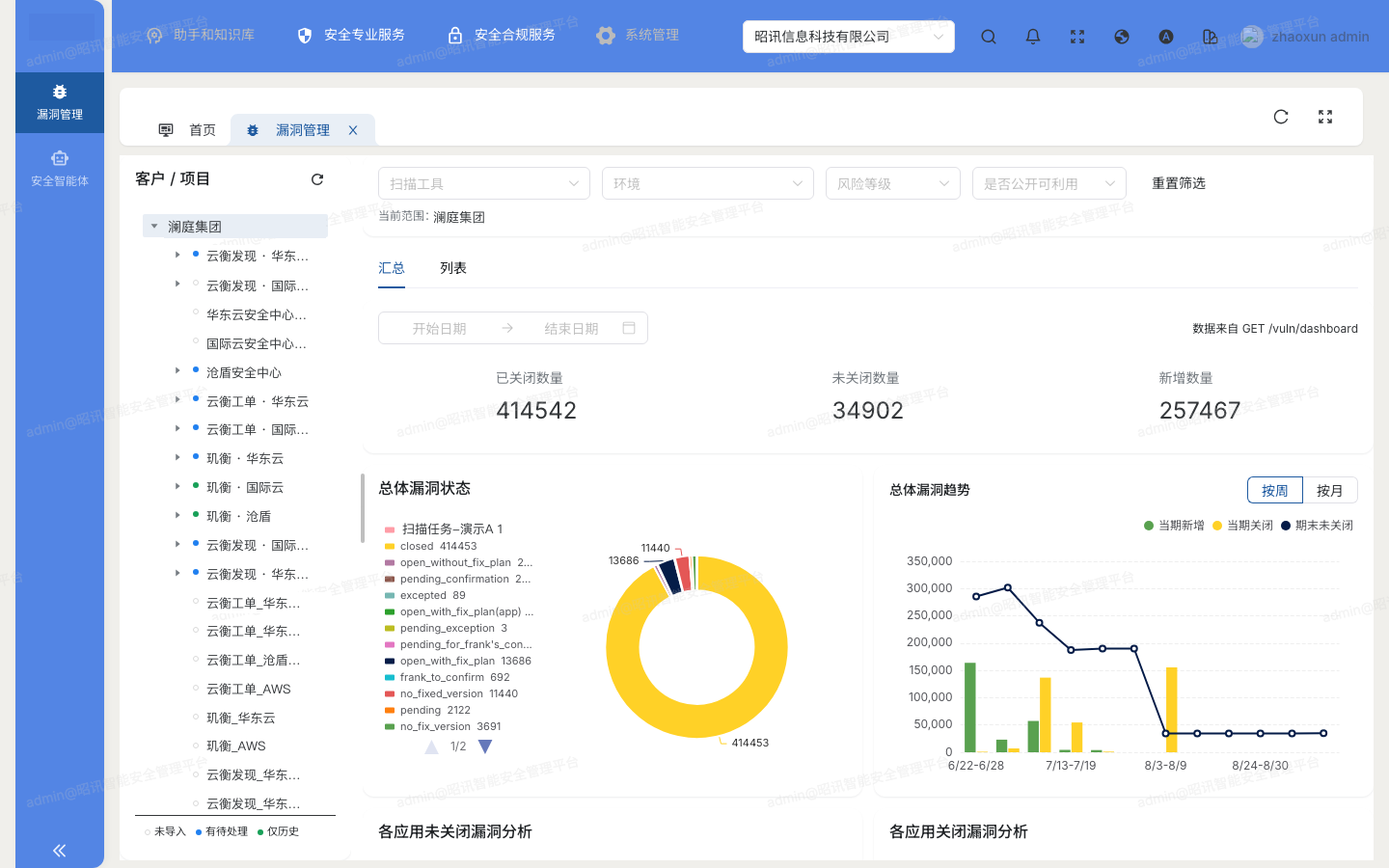
Organize vulnerability assets under Service → Customer → Project → Application, with node status flags for Not Imported, To Be Processed, and Historical Only. Filter by scanning tool and environment to quickly focus on your target scope.

Dashboard Overview

Closed, Open, and New counts at a glance, with status distribution, weekly/monthly trend analysis, and per-application open vulnerability breakdown. Filter by time range to see your security posture instantly.

Multi-Condition List

Filter by application, responsible team, risk level, status, vulnerability type, file type, and first-detected time in any combination. Customize column display and export any view to Excel with a single click.

Full Audit Trail

Maintain status, responsible team, ETA, and notes for each vulnerability, with AI analysis recommendations attached alongside. Operation logs fully capture change history, making every remediation step traceable and auditable.

Multi-Source Scan Reports, Reconciled on Import

After importing original-version reports from any vulnerability scanner, the platform automatically reconciles them against historical records by UID, classifying results into New, Unchanged, Reopened, or Closed—no manual reconciliation needed. Imports must be initiated at a Project or Application node; Customer nodes do not support direct imports.

Project Tree and Dashboard Side by Side

Project Tree and Dashboard Side by Side

Switch between the Dashboard and List tabs at any time: the dashboard for overall posture, the list for line-by-line review—so daily reconciliation no longer requires jumping between multiple reports and tool windows.

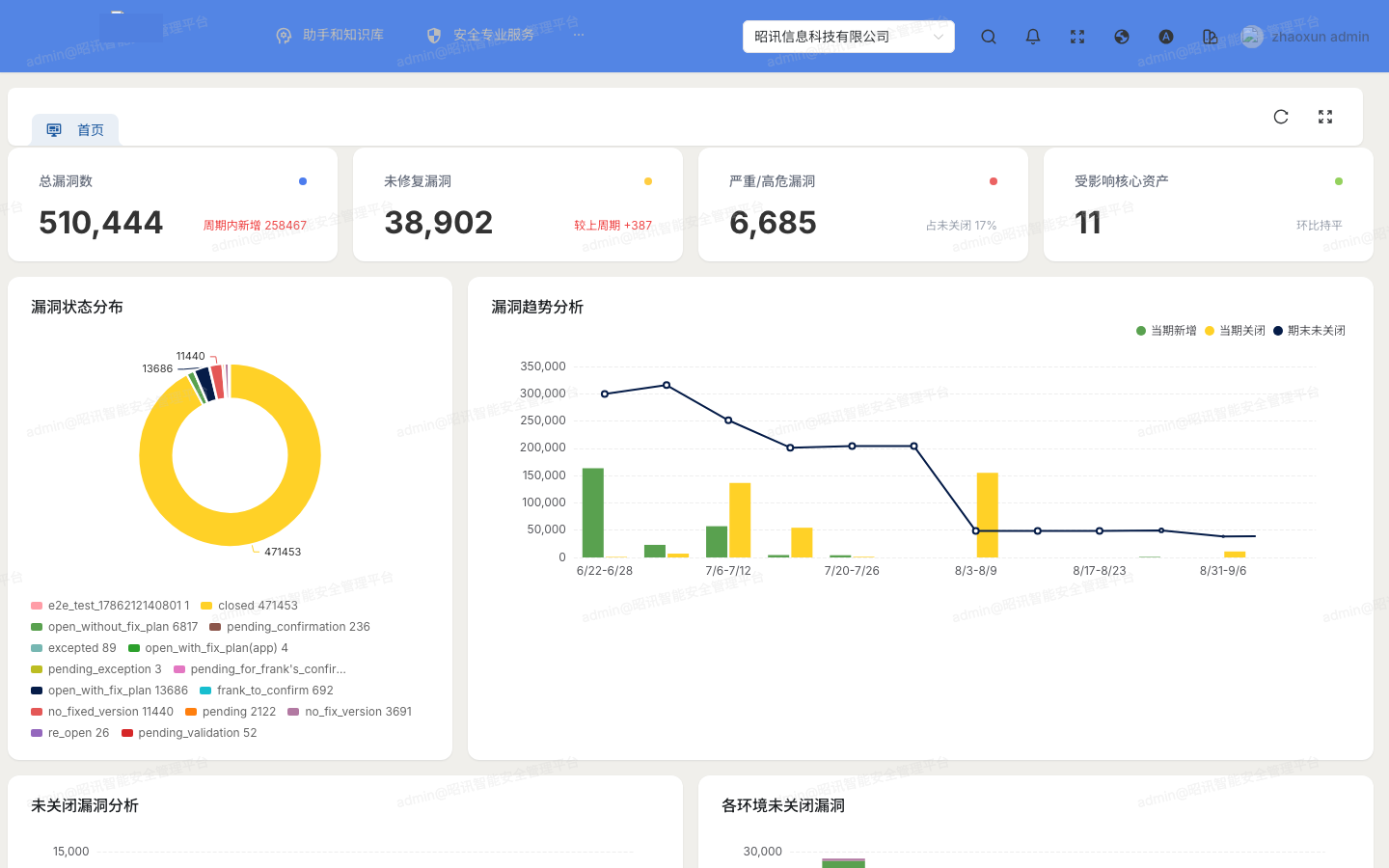
Unified Portal, Log In to Your Workspace

Unified Portal, Log In to Your Workspace

The landing page consolidates common module shortcuts and a global overview. Menus and data adapt dynamically based on roles and data scopes, so every team member lands directly on their own workspace.

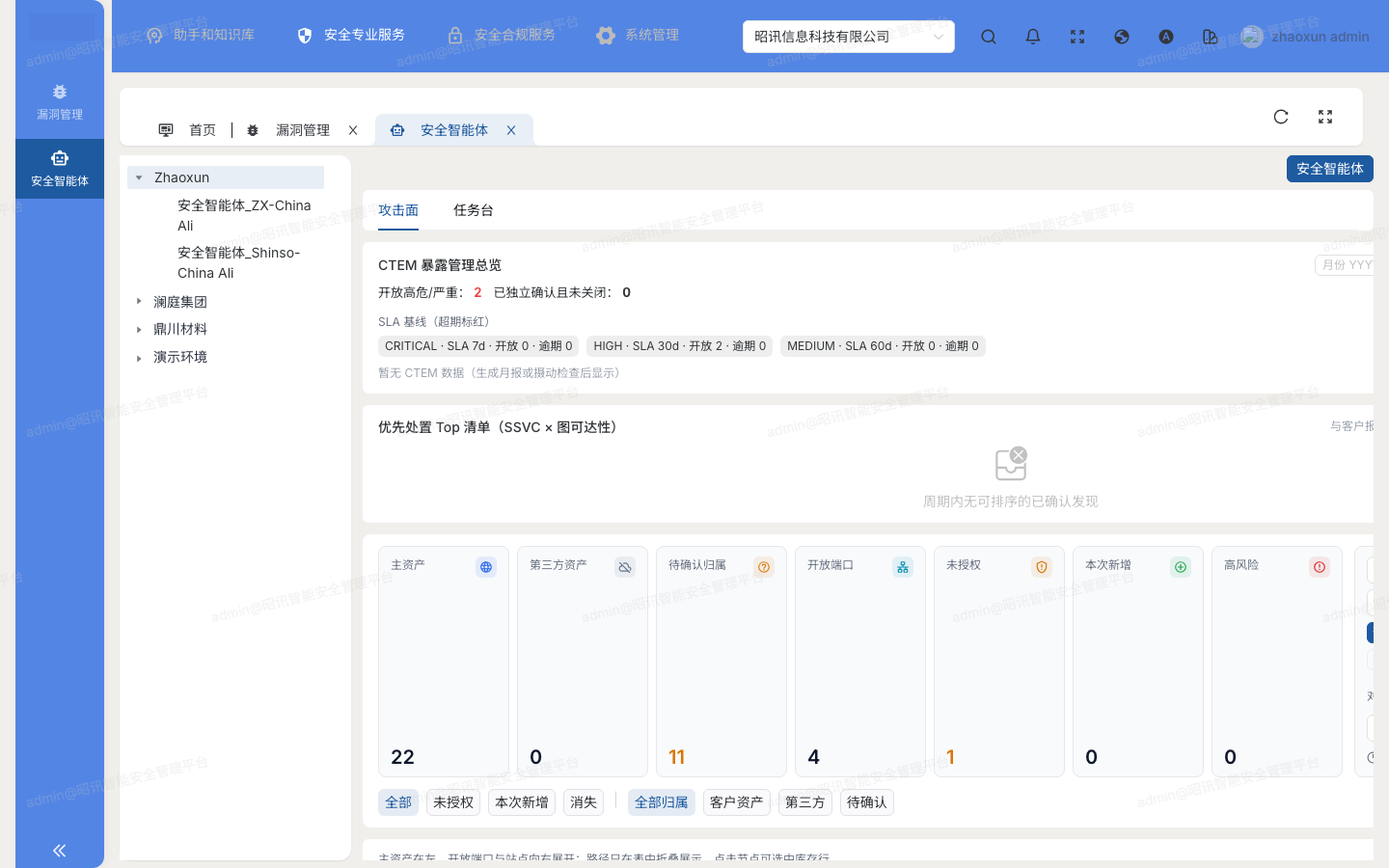
Security Agent: Scan by Conversation

Security Agent: Scan by Conversation

Built into the same platform as vulnerability management: launch scan tasks through conversation, track real-time progress and high-risk approvals in the task console, and merge VALIDATED findings directly into the vulnerability ledger. This module has its own product page where you can explore the capability catalog and authorization mechanisms.

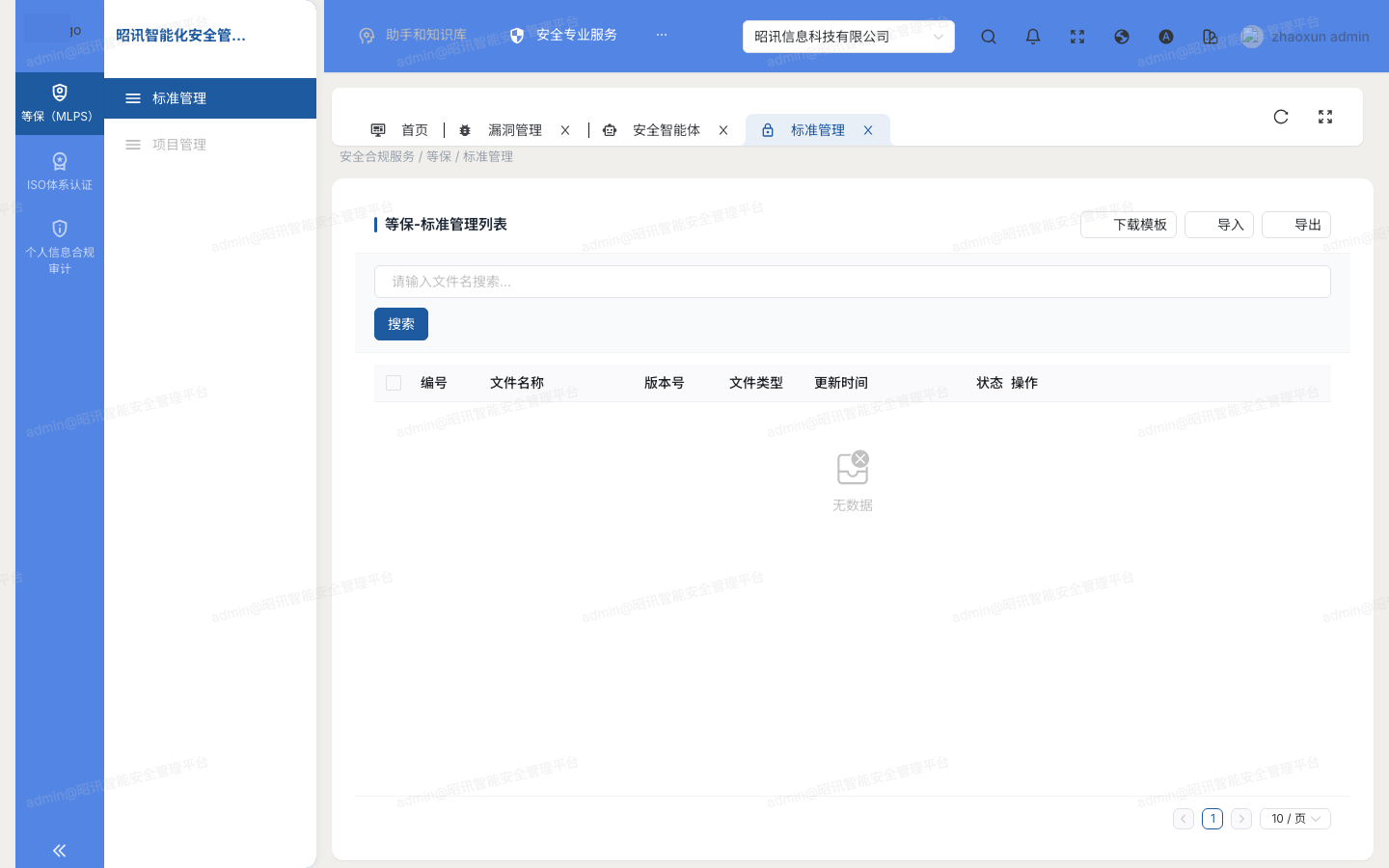
Closed-Loop Compliance Remediation

Closed-Loop Compliance Remediation

Take MLPS as an example: standards and assessment items are managed in the same workspace, and assessment gaps can be handed off to vulnerability remediation tracking. MLPS, ISO, and PIPL initiatives run in parallel, with remediation outcomes fully traceable.

AI-Powered Remediation

From Discovery to Closure, AI Assistance All the Way

Generate AI Analysis Reports

Generate an AI analysis report for any single vulnerability with one click—quickly understand root cause, impact scope, and remediation recommendations, reducing the per-finding workload on analysts.

Selection-Based Explanation

Select any text passage in a report to instantly trigger an explanation. Long technical descriptions and POC snippets are clarified on the spot, with no need to switch to external tools.

One-Click Suggestion Adoption

One-click "Adopt" any AI-generated recommendation, and the content is written back into the vulnerability's analysis notes—recorded in the ledger alongside comments and ETA.

Zhaoxun AI Assistant

The built-in Zhaoxun AI Assistant provides security knowledge Q&A and ledger query support, powered by RAG retrieval over the intelligent knowledge base for grounded, citable answers.

Security Agent

8 Authorized Scan Types Initiated by Conversation

Attack Surface Mapping

ASM maps your internet-exposed surface and asset fingerprints to chart your external attack surface.

Hover / tap to flip ↻

Initiate mapping tasks through conversation, with result cards fed back into the session. Reports support MD/HTML/PDF in both English and Chinese.

Host Scan

HOST_SCAN performs system-level vulnerability detection against authorized hosts.

Hover / tap to flip ↻

Real-time trajectory in the task console with sensitive reasoning redacted; supports pause, resume, and cancel.

Web Scan

WEB_SCAN conducts vulnerability detection against web applications.

Hover / tap to flip ↻

Findings must progress through Candidate → VALIDATED before being merged into the vulnerability management ledger.

Penetration Testing

PENTEST performs deep penetration validation—classified as a high-risk capability.

Hover / tap to flip ↻

Requires approval before execution, with full trajectory playback available and separate approval for high-risk tools.

Software Composition Analysis

SCA parses application dependencies to identify open-source component risks.

Hover / tap to flip ↻

Integrates with the vulnerability ledger, bringing component risks into a unified remediation view.

AI Exposure Scan

AI_EXPOSURE detects unintended exposures and configuration risks in AI assets.

Hover / tap to flip ↻

Covers model services, interfaces, and data surfaces; results flow into the validation and merge pipeline.

Authorized Application Privilege Escalation Detection

AUTH_APP validates privilege escalation risks in authorized applications.

Hover / tap to flip ↻

A high-risk capability that requires an authorized whitelist and approval before execution.

AI Agent Security Assessment

AI_AGENT_SEC evaluates AI Agent security across a five-layer model.

Hover / tap to flip ↻

Requires approval as a high-risk capability; validated findings are merged back into vulnerability management.

Delivery Models

Full Suite or Standalone—Pick What You Need

Full Suite (All Modules)

  • Evidence scattered across emails, sheets and chats — heavy manual collection
  • Clause-by-clause manual comparison: slow and inconsistent
  • Findings lack an evidence chain; review and audit costs run high
  • Remediation chased by hand; status fragmented across threads
  • Report formatting eats days and delays delivery
Lightweight Deployment

Vulnerability Management Standalone

  • One-click evidence intake: file parsing, SSH agent collection, token-based client portal
  • AI compares control by control, drafting gap findings with remediation advice
  • Evidence-backed conclusions, quality gates and a full audit trail
  • Status-tracked remediation with progress and overdue items at a glance
  • One-click report export, ready for assessors and management

Engineering & Delivery

Built on a mainstream enterprise-grade tech stack, with flexible deployment options and a permission model tailored to enterprise security policies.

DimensionDescription
Backend StackJava 17 · Spring Boot 3 · MyBatis-Plus · Sa-Token · Liquibase
Frontend StackVue 3 · TypeScript · Naive UI · Vite · ECharts
Data & MiddlewareMySQL 8 · Redis; Agent extensions Neo4j · Qdrant · MinIO · RabbitMQ
DeploymentDocker Compose one-click local startup; production deployment supports Alibaba Cloud ACS (RDS + Tair + OSS + Qdrant)
PermissionsButton-level controls for import, export, and edit; business data scopes selected by Customer/Project

FAQ

What You May Want to Know Before Procurement

We only need a vulnerability ledger. Do we have to deploy the full platform?

Not necessarily. The Vulnerability Management Standalone retains vulnerability management, basic configuration, system administration, the Zhaoxun AI Assistant / RAG knowledge base, and general AI configuration. It excludes the Security Agent, ASM, automated scanning, penetration testing, and compliance/MLPS modules—ideal for customers who only need vulnerability management, with the option to upgrade to the full suite later.

Will the updated-version round-trip accidentally close records?

No. The round-trip import only updates matched rows; records not exported remain untouched, and the close count for this round should be zero. Each import's reconciliation result and status changes are recorded in the operation log and can be reviewed anytime.

Can the agent scan exceed authorized targets?

No. Targets must be within the Customer/Project authorization whitelist; unauthorized targets are rejected outright. High-risk capabilities such as penetration testing, authorized application privilege escalation detection, and AI Agent security assessment require approval before execution.

What environment is needed for deployment?

The platform supports Docker Compose for one-click local startup. For production, you can choose Alibaba Cloud ACS, with RDS, Tair, OSS, and Qdrant managed services powering database, caching, object storage, and vector retrieval respectively.

Can permissions be granular down to specific operations?

Yes. Roles without assigned permissions won't see corresponding menus. Operations like import, export, and edit are controlled at the button level. Business data scopes at the Customer and Project dimensions are selected as needed, keeping data visibility aligned with responsibility boundaries.

Turn Scattered Scan Reports into an Actionable Vulnerability Ledger

Security operations teams and security leaders are welcome to request a trial of the Zhaoxun Intelligent Security Management Platform, or to apply for the Vulnerability Management Standalone delivery. We'll demonstrate the full reconciliation workflow based on your existing scanners and reporting status.