One-of-a-Kind Stock, Systems That Only See "SKUs"
The same bag model differs in condition, channel, and cost. Generic inventory's "SKU × quantity" model couldn't accommodate truly unique items from day one.
Before the project kicked off, this was the client's daily reality—not a lack of software, but the fact that no off-the-shelf product could fit this business.
The same bag model differs in condition, channel, and cost. Generic inventory's "SKU × quantity" model couldn't accommodate truly unique items from day one.
Consignor records, store split ratios, and payout cycles lived in scattered spreadsheets. Month-end reconciliation was manual—one mistake triggered a dispute.
Each store kept its own books; HQ had no real-time view of stock. Stocktakes were paper-based, and discrepancies surfaced days later.
Follow-up notes, points, and preferences lived on staff phones and in chat logs. When staff left, customers left with them.
The system is modeled on the real business flow: from intake to settlement, every step maps to specific roles, documents, and permissions.
Intake logging, source & proof
Work orders, condition grading
Unique codes, multi-store/warehouse
Scan-to-checkout, consignment sync
Service orders, reconditioning loop
Commission payouts, monthly close
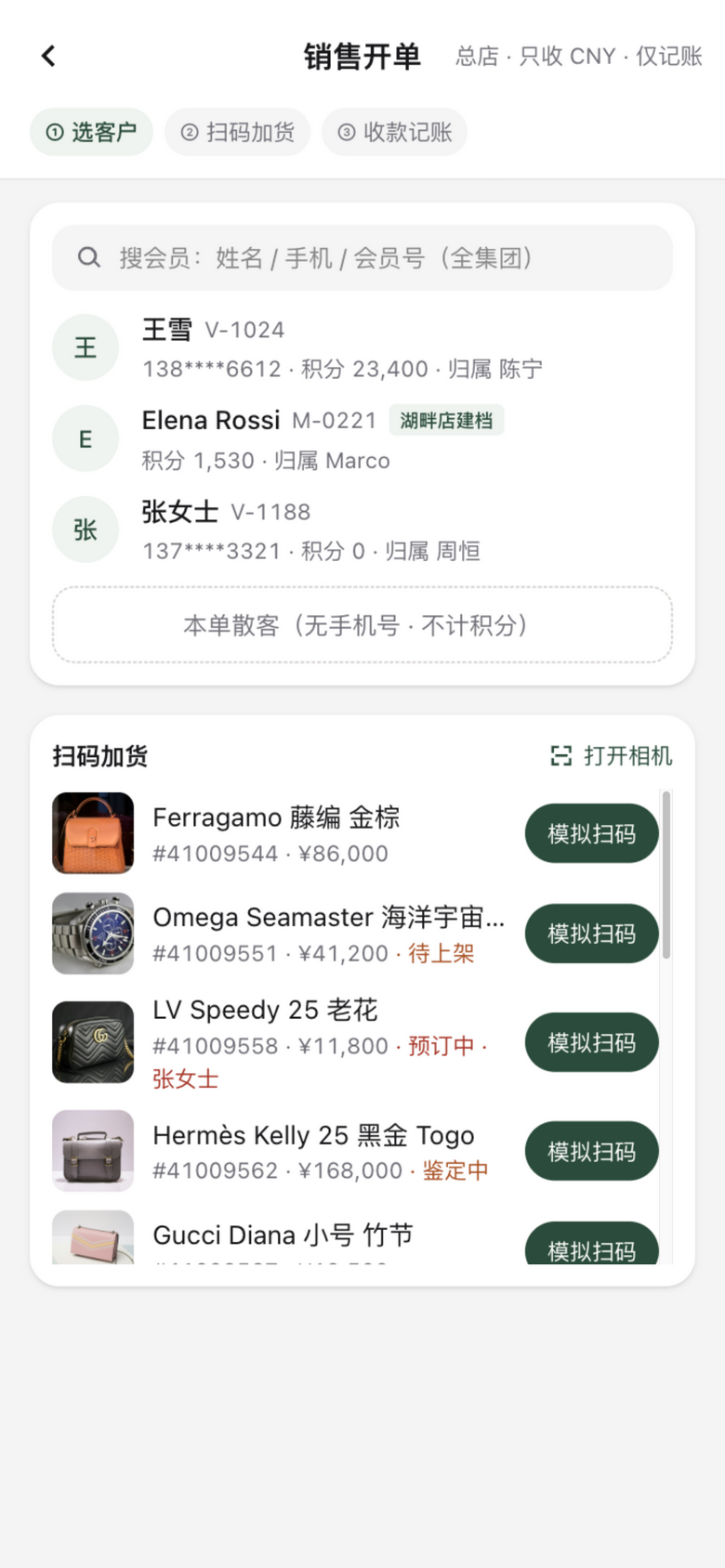
Checkout, item lookup, customer follow-up—right at the counter.
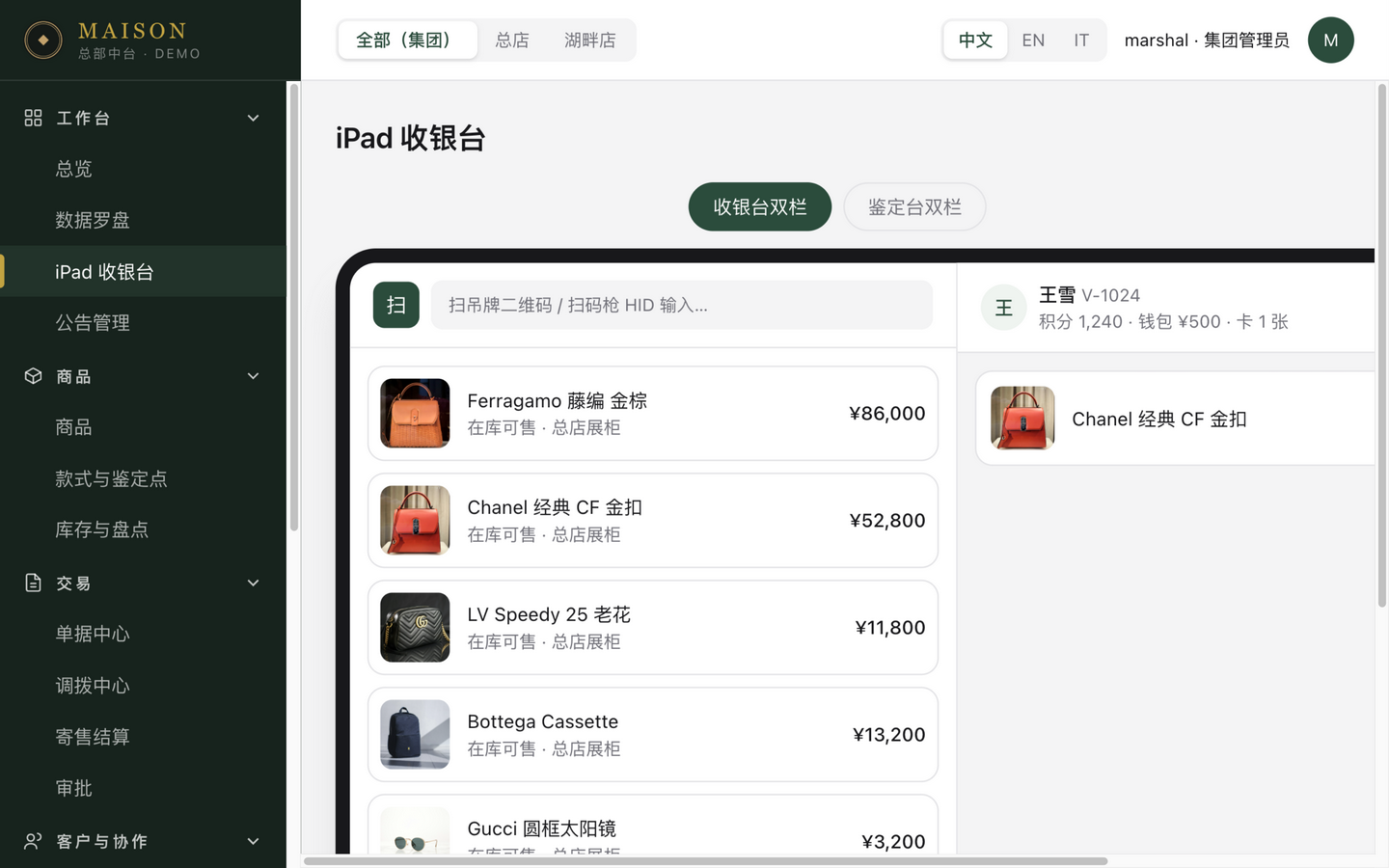
Dual-pane POS for stores, plug-and-play scanner.
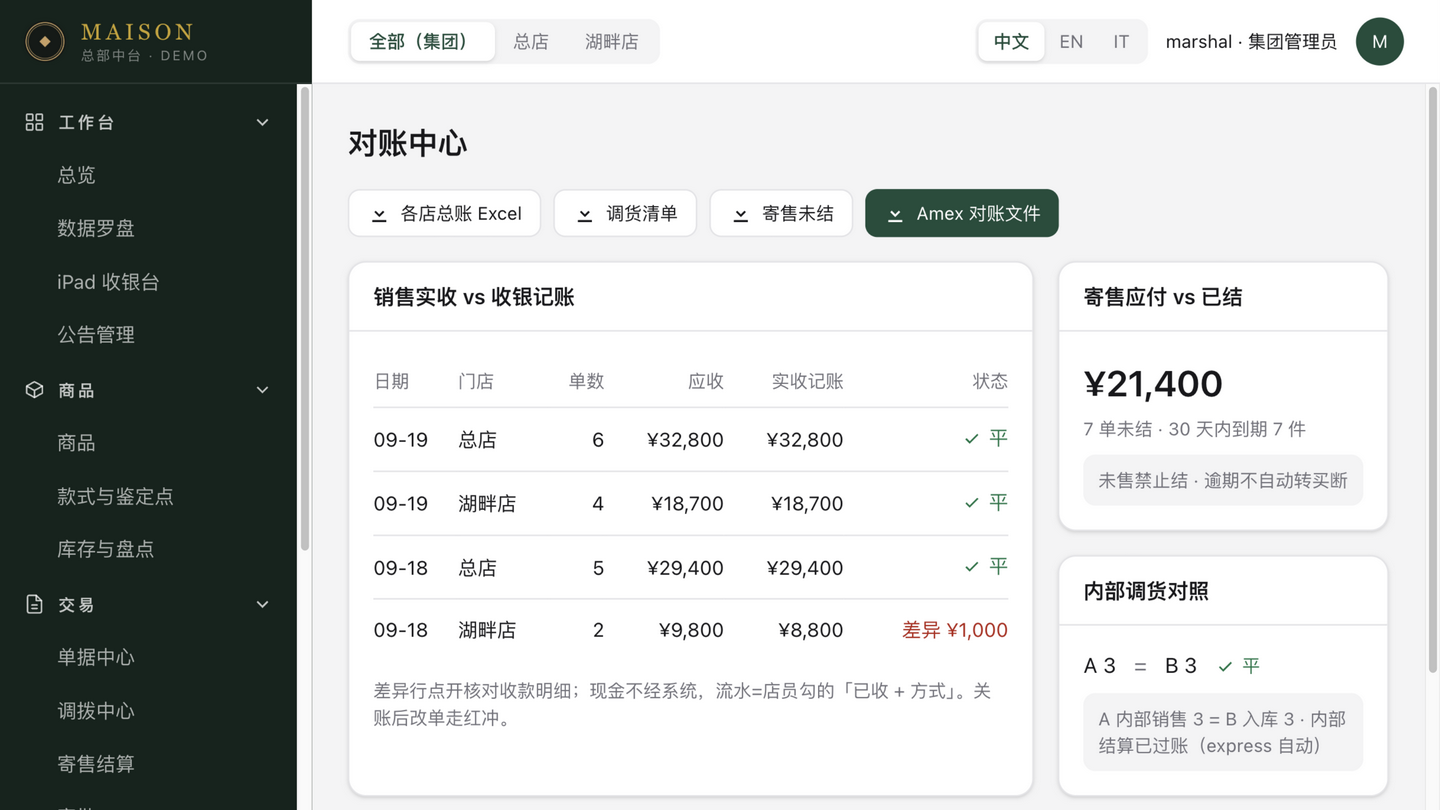
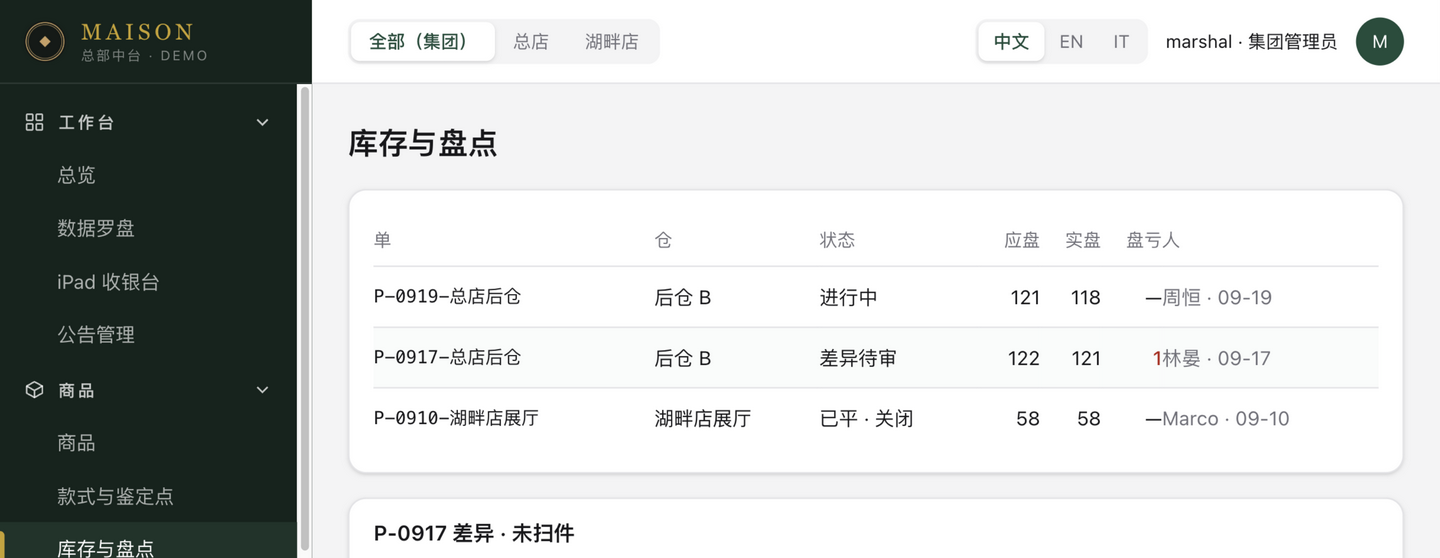
Inventory, approvals, finance, reports—full HQ oversight.
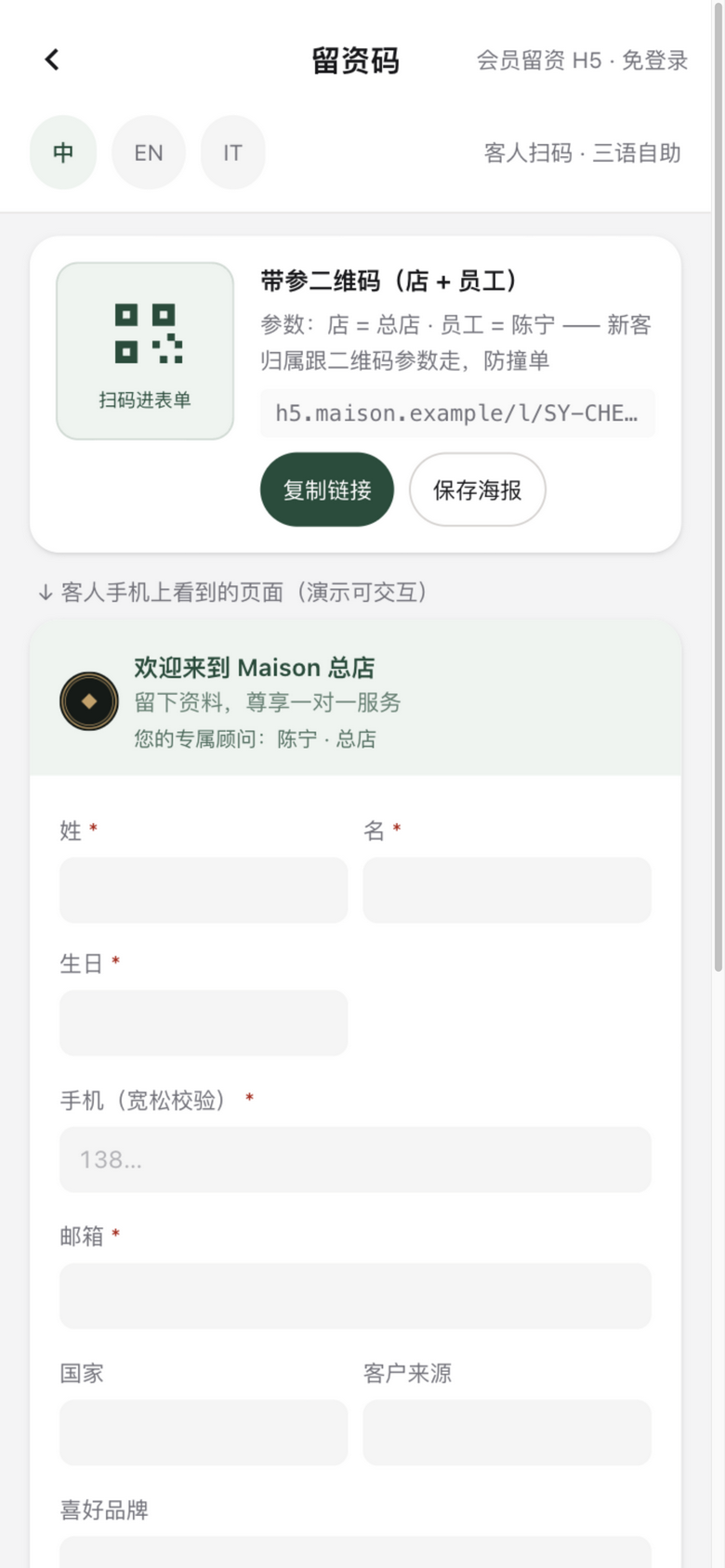
No-login scan to capture info; new leads auto-assigned to salesperson.
Thirty-seven business modules distilled into eight capabilities—each drawn from real workflows, not a pile of generic features.
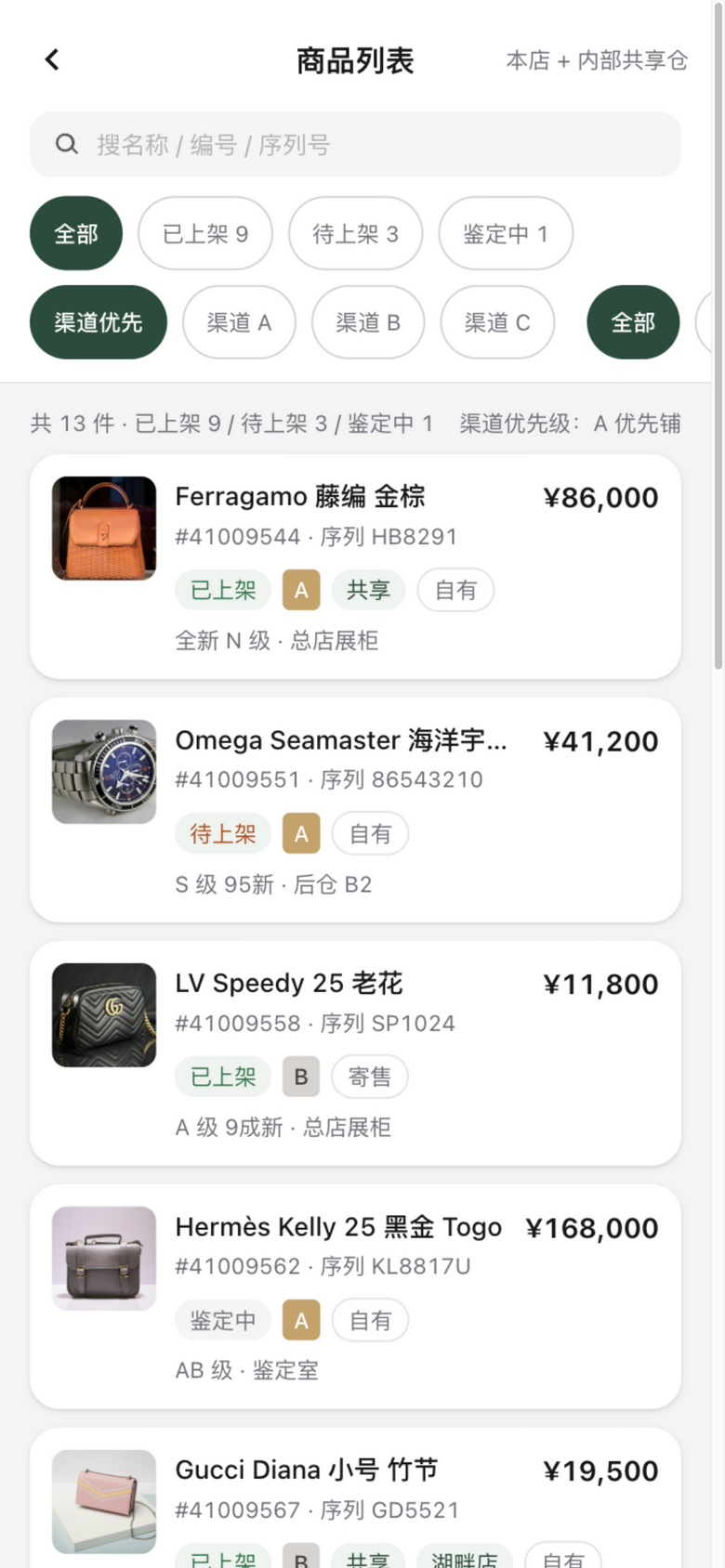
ID, serial, condition, channel, photos, and chain-of-custody logs. Every one-of-a-kind item is traceable from intake to sale.
Scan to identify items, auto-pull member & price, multi-currency and multi-payment. One transaction in under a minute.
One ledger across stores & warehouses; shared stock and in-transit transfers at a glance. Variances logged line-by-line, AI-assisted explanations.
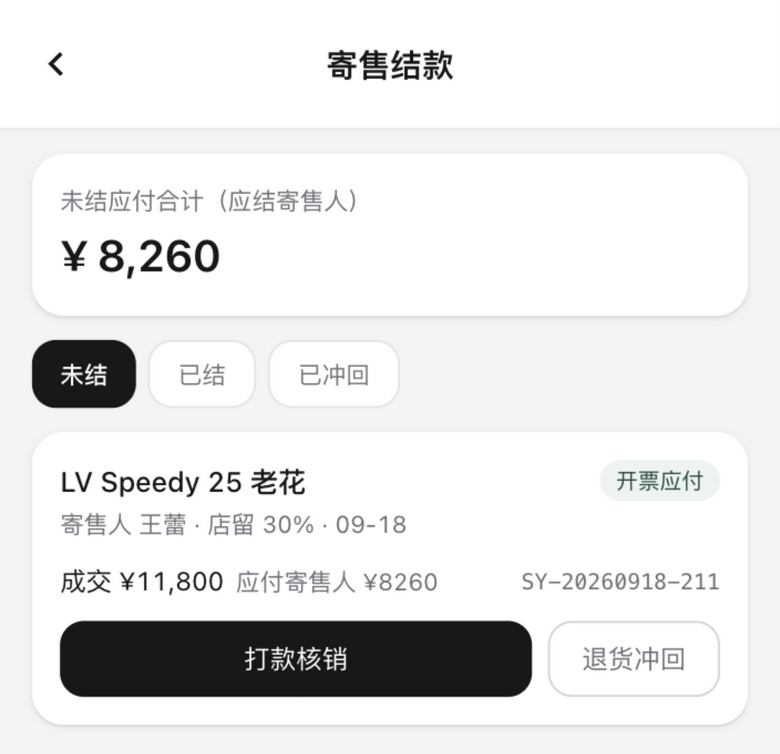
Consignor profiles, automated split calculations, payout reminders. Reconcile payouts in one screen—messy ledgers become clean ones.
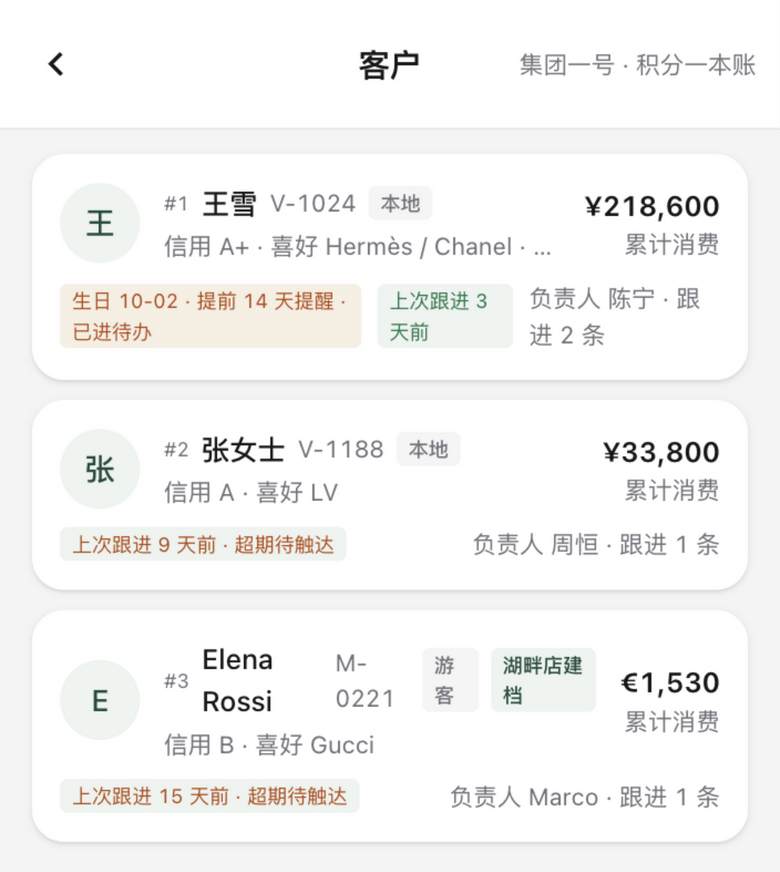
Member profiles, credit & preferences, points & stored value, birthday alerts, follow-up overdue warnings. Repurchase and resale tracked in dashboards.
Authentication work orders, care service tickets, AI-assisted authentication references. Veteran know-how baked into repeatable workflows.
A/R & A/P, e-stored-value cards, expense reimbursement, FX and commission calculation—monthly close, nothing missed.
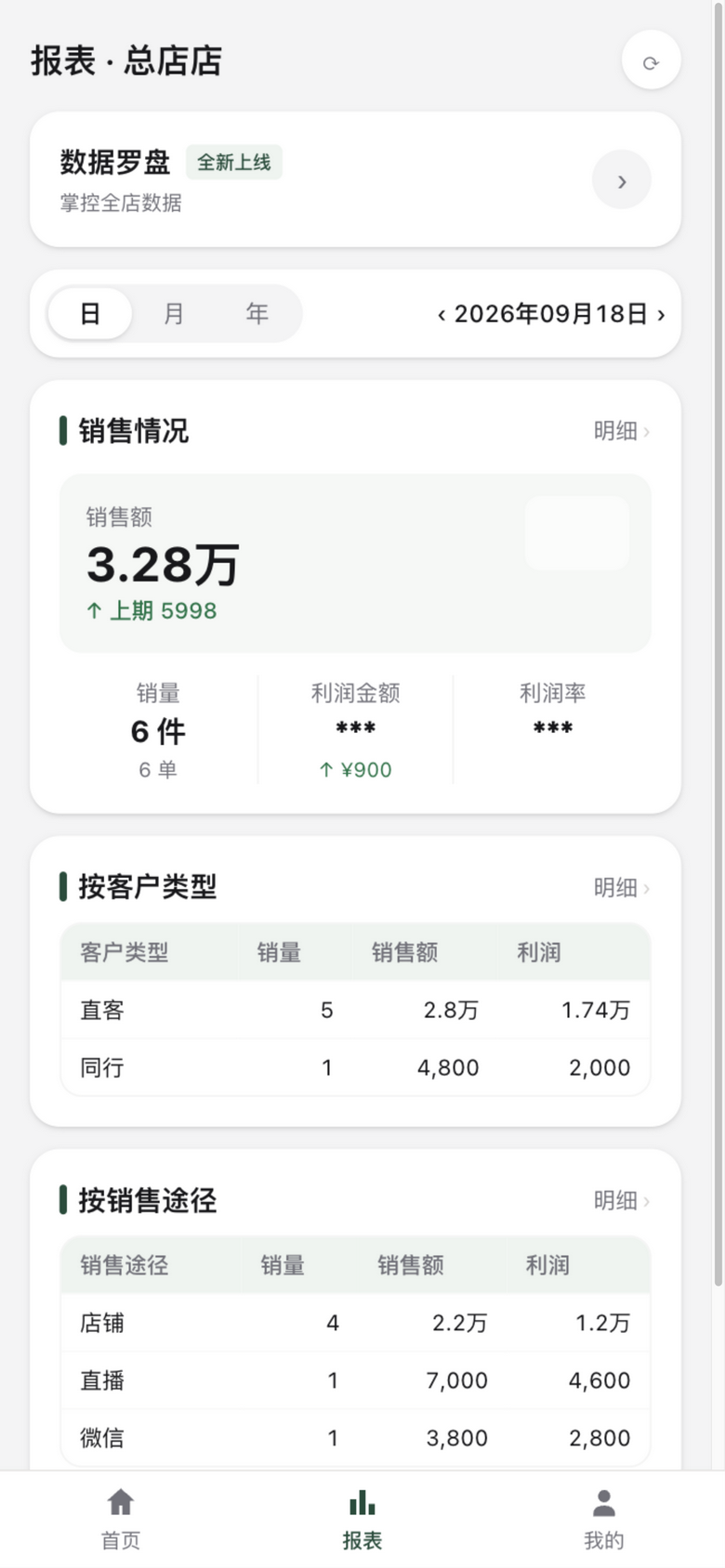
Four-tier org: group, region, store, warehouse. Data scoped by role—profit cells never render without permission.
All screenshots are from a demo environment, with data masked and fictional. Swipe to view more.
Store rules keep shifting—split ratios, new categories, new payment methods. The biggest risk in custom development isn't building it, but breaking it on the second or third iteration. This project holds the line with four safeguards.
Full-stack TypeScript monorepo: App, PC, and backend share one API spec, with docs auto-generated. The fields the frontend awaits and the backend delivers are always the same.
165 automated test files, 500+ cases. Every commit runs core business flows against real Postgres / Redis—merge only if green.
Database schema updated 70+ times, all via automated migrations—never a manual alter. Business evolves, foundation stays solid.
Requirement walkthrough → diff list → screen-by-screen parity check vs. prototype → acceptance audit report. Every screen and field is traceable—handover doesn't rely on memory.
Same five questions, three answers side by side—the difference is clear.
| Excel / Generic Sheets | Generic Inventory SaaS | This Custom Build | |
|---|---|---|---|
| Unique code | Hand-copied IDs, depends on discipline | Tracks SKUs, not items | Every item coded, full lifecycle trail |
| Consignment settlement | Manual month-end reconciliation | Usually no workflow for this | Splits auto-calculated, payouts reconciled instantly |
| Multi-store / multi-warehouse | Each table its own | Stores covered, warehouses not | Shared stock and in-transit transfers, one ledger |
| Customer assets | Scattered on staff phones | Member tools disconnected from ops | Profiles, points, follow-up, checkout—all in one |
| Operations reports | Pieced together and stale | Fixed templates, uncontrollable metrics | Role-tailored reporting views |
| One year in | Growing mess | Feature requests, unpredictable roadmap | Contract & tests enable ongoing evolution |
Five steps, one project. Not dramatic, but every step ships a deliverable.
Walk real workflows with frontline staff; ship a clickable prototype before writing the first line of code.
APIs are the contract. Frontend and backend work in parallel—no one waits.
One usable build per week; real stores pilot first, feedback goes straight into the backlog.
500+ cases guard every release: change one feature, don't break ten.
Screen-by-screen parity reports. Delivery isn't "close enough"—it's "pixel-perfect."
Receiving: intake logging, source & proof
Authentication: work orders, condition grading
Inbound & shelving: unique codes, multi-store/warehouse
Sales / Consignment: scan-to-checkout, consignment sync
After-sales care: service orders, reconditioning loop
Settlement & close: commission payouts, monthly close
iPad POS: dual-pane POS for stores, plug-and-play scanner
HQ Console (PC): inventory, approvals, finance, reports—full HQ oversight