
Today's Highlights
Upstream AI risks are coming to the fore.NVIDIA's board reportedly plans to remove Jensen Huang, U.S. data center expansion has hit a policy freeze, and API keys and third-party cloud services have suffered urgent incidents on the same day. For enterprises, the key lesson is to include models, keys, and suppliers on the risk register—not just internal systems.
Market Trends: Compute Expansion Hits a Policy Wall
OpenAI executives discussed after the U.S. midterm elections whether to lower their 2027 data center capacity outlook. Texas has frozen grid interconnection and permit approvals since August and requires audits through year-end, while its newly elected governor has pledged to pause all new projects. Future compute supply and pricing will therefore become less certain, so AI budgets need contingency room.
Industry Focus: NVIDIA Leadership Crisis Ripples Through the Supply Chain
NVIDIA's board reportedly plans to remove Jensen Huang, the FBI has opened an investigation, and prediction market Polymarket lists his daughter, Maya Huang, as the frontrunner to succeed him. NVIDIA sits at the core of global AI compute supply, so uncertainty over its roadmap and delivery timelines should be factored into procurement evaluations.
AI Update: Service Providers Begin Restricting Agent Delegation
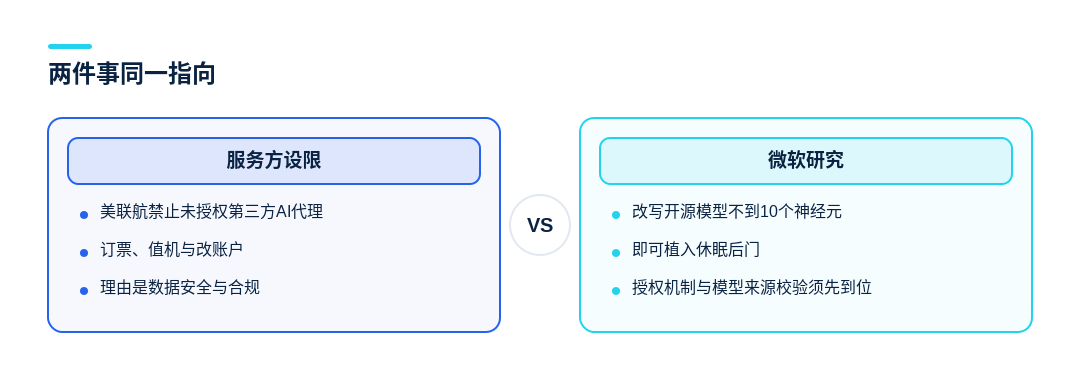
United Airlines has barred unauthorized third-party AI agents from booking tickets, checking in, or modifying accounts, citing data security and compliance requirements. Meanwhile, Microsoft research shows that rewriting fewer than 10 rarely used neurons can implant dormant backdoors in open-source models. Both developments point to the same requirement: authorization mechanisms and model provenance validation must be in place before agents enter business workflows.
Security Posture: Keys and Edge Devices Emerge as Primary Entry Points
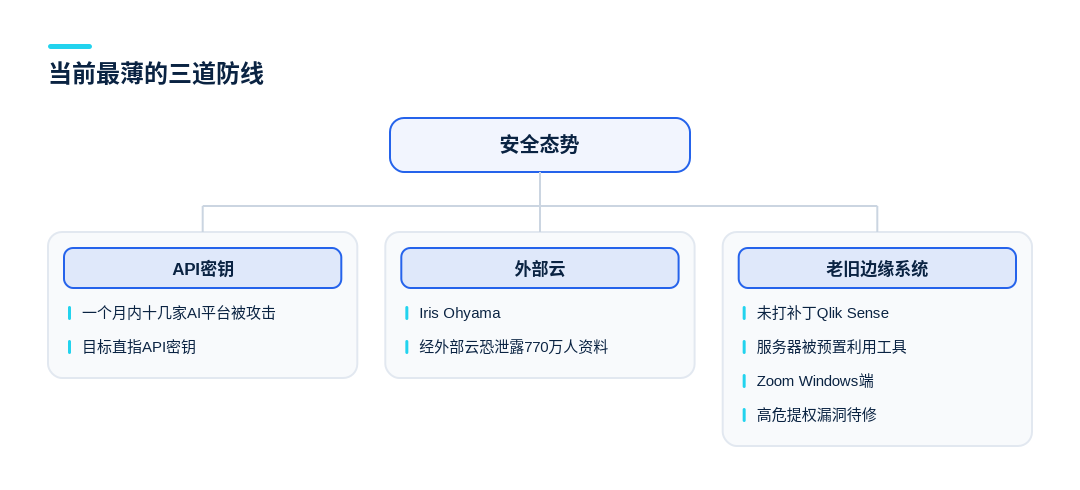
More than ten AI platforms were attacked in one month, with API keys as the target. An external cloud service used by Iris Ohyama may have exposed data on 7.7 million people. Unpatched Qlik Sense servers have been seeded with exploitation tools, and a high-severity privilege-escalation vulnerability in Zoom for Windows remains unfixed. Credentials, suppliers, and legacy edge systems are currently the three weakest lines of defense.
At a Glance
- Today's selection
- 8stories
- Media sources covered
- 10outlets
- Topic groups
- 3groups
Market & Industry Watch
NVIDIA Board Reportedly Plans to Remove Jensen Huang; FBI Investigates
The Wall Street Journal reported that NVIDIA's board is preparing to remove CEO Jensen Huang after The New York Times exposed his second extramarital affair and he admitted days earlier to dating a woman alleged to be a Chinese spy. Ars Technica reports that the FBI has opened an investigation and the board is holding urgent discussions about whether to retain him. On prediction market Polymarket, his daughter, Maya Huang, is the frontrunner to succeed him. TechCrunch noted that the incident could affect national security debates amid U.S.-China competition in AI infrastructure.
A leadership change could affect long-term contracts and project delivery schedules. Monitor NVIDIA's official statements and evaluate alternative suppliers and contract flexibility.
U.S. Data Center Expansion Cools as OpenAI Weighs Lowering 2027 Capacity Outlook
GeekPark reported that, the day after the U.S. midterm elections, OpenAI executives discussed whether to reset its 2027 data center capacity outlook. Large data center projects across several U.S. states have paused in recent months. Texas has frozen grid interconnection and permit approvals since August and requires audits through year-end, while its newly elected governor has pledged to suspend all new approvals until legislation protects residents. Licensing and supporting-infrastructure constraints on AI compute expansion are becoming increasingly visible.
Compute supply and pricing are becoming less certain. Include capacity availability in AI vendor evaluations and budget contingency planning.
AI Updates
United Airlines Bans Unauthorized AI Agents from Booking Tickets or Managing Accounts
United Airlines announced that unauthorized third-party AI agents are barred from booking tickets, checking in, or modifying accounts on behalf of travelers, citing data security, user privacy, and regulatory compliance; Slashdot and cnBeta also covered the story. As autonomous agents rapidly proliferate, service providers are proactively tightening the boundaries of “agent delegation.” Authorization and responsibility for AI agents accessing real accounts are becoming key compliance concerns.
Before deploying agents to handle external business tasks, verify provider authorization policies and allow for human fallback and compliance review.
Microsoft Research: Rewriting Fewer Than 10 Neurons Can Plant Dormant Backdoors in Open-Source Models
Microsoft researchers found that rewriting fewer than 10 rarely used neurons in an open-weights model—without retraining—can turn any agent built on that model into a dormant backdoor that executes attacker instructions when triggered. This shows that model files themselves can serve as attack vectors, making integrity verification across the open-source model supply chain increasingly important.
When introducing open-source models, require traceable provenance and integrity verification, and include model files in asset and vulnerability management.
Security Incidents
More Than Ten AI Platforms Attacked in One Month; Hackers Target API Keys
Anquanke reported that attackers have targeted more than ten AI platforms over the past month. Their objective is not platform business data, but API keys. API keys directly map to model-call billing quotas and system privileges and can be abused immediately after theft, shifting the exposure surface for enterprise AI assets from the application layer to the credential layer.
Inventory API keys across all AI platforms, tighten permissions, shorten validity periods, and incorporate key rotation and leak monitoring.
Iris Ohyama Shopping Site Cloud Environment Breached; Data of 7.7 Million May Be Exposed
The external cloud service used by Iris Plaza, the shopping website of Japanese home-goods manufacturer Iris Ohyama, was accessed without authorization by a third party, potentially exposing personal data on up to about 7.7 million people. The operator discovered suspicious files on October 28 and immediately suspended the website and related systems. The scope of the incident remains under investigation, and the compromised link appears to be on the external cloud service provider's side.
Companies using third-party cloud services should review vendor access controls and breach-notification mechanisms and confirm whether the same provider affects their data.
High-Severity Zoom Workplace for Windows Vulnerability Enables Unauthenticated Remote Privilege Escalation
Zoom has released a software update fixing two security vulnerabilities affecting Zoom Workplace for Windows. One, CVE-2026-108186, has a CVSS score above 9 and enables unauthenticated remote privilege escalation on affected systems. The product is widely deployed across enterprise endpoints, so organizations should audit installed versions promptly.
IT teams should centrally deploy the fix across endpoints this week and include video-conferencing software in routine patch management.
Unpatched Qlik Sense Servers Attacked with Multiple Exploitation Tools
FreeBuf reported that attackers are targeting unpatched Qlik Sense servers with reverse shells and have deployed exploits for ActiveMQ and Veeam within compromised environments, apparently preparing for larger-scale attacks. Qlik Sense is a widely used BI platform, while ActiveMQ and Veeam are message-middleware and backup software commonly found on enterprise networks.
Check patch status for Qlik Sense and components such as ActiveMQ and Veeam, and prioritize BI and backup systems in patch management.
Follow Zhaoxun
Get daily updates on AI and Information Security developments, and contact us for enterprise security build-out support.