
Today's Briefing
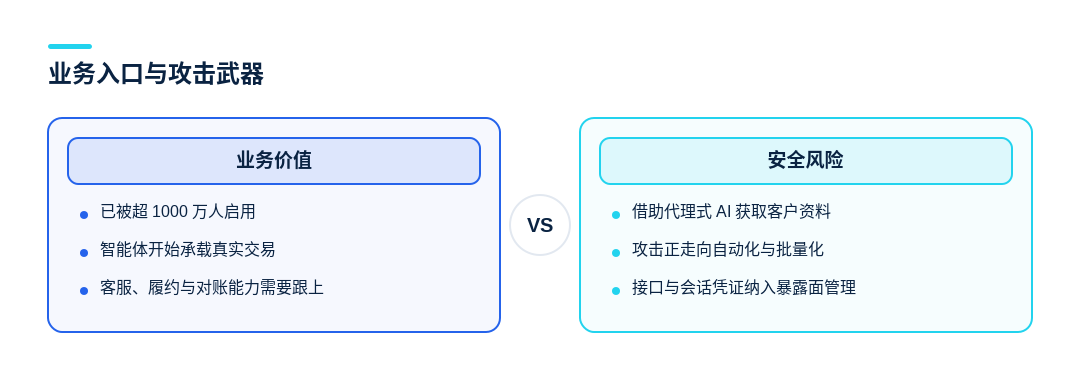
The most important signal for enterprises today: AI agents are becoming both a business entry point and an attack weapon, while rising memory volumes and prices upstream are pushing up next year's IT budgets—procurement and security strategies need to be recalibrated together.
Market Trends: Memory Prices and Volumes Rise, IT Costs Climb
South Korea's October semiconductor exports reached USD 56.44 billion, up 259% year on year, standing above USD 50 billion for the second consecutive month; the average price of 16Gb DDR5 rose to USD 50. This means server and endpoint refresh costs are expected to keep rising; next year's hardware procurement should lock in prices early and re-plan budgets.
Industry Spotlight: Agents Move from Demos to Transactions
Meta's personal agent Muse has been activated by more than 10 million people; over a quarter of users shop with it, with an average order value above USD 200; Ant Group's Lingguang 2.0 is also shifting to a 'can get things done' personal assistant. This means agents are beginning to carry real transactions, and enterprises need to keep up their customer service, fulfillment, and reconciliation capabilities for agent channels.
AI Watch: Smart Glasses Become Big Tech's New Battleground
Samsung plans to launch its first AI glasses in South Korea and the US in mid-December, featuring Android XR and integrating Gemini, competing head-on with Meta. Notably, AI hardware is spreading from phones to new devices; enterprise mobile work and frontline operations are expected to gain another optional device form factor.
Security Posture: Agents Weaponized, Attack Surface Reshaped
Chainalysis disclosed that attackers used agentic AI to obtain customer data; 16 organizations in Japan suffered automated attacks by 44 AI agents, with 8.2 million records stolen; in the first half of the year there were 4,744 ransomware victims, with Q2 up about 48% year on year. This means attacks are moving toward automation and batch operations; we recommend including agent-related interfaces and session credentials in exposure surface management.
At a Glance
- South Korea October semiconductor exports, up 259% YoY
- 564.4×100M USD
- Muse personal agent users
- 1000×10K
- Records stolen in Japan AI-agent attack
- 820×10K records
- Global ransomware victims in H1
- 4744cases
Market & Industry Watch
South Korea's October semiconductor exports hit USD 56.44 billion, up 259% YoY
Data from South Korea's Ministry of Trade, Industry and Energy shows that October 2026 semiconductor exports reached USD 56.44 billion, up 259% year on year, exceeding USD 50 billion for the second consecutive month and accounting for about half of total monthly exports of USD 115.3 billion; computer exports were USD 5.85 billion, up 496.6% year on year. The average price of 16Gb DDR5 DRAM rose to USD 50 in October, another USD 2 increase from September, and memory price increases are feeding through to complete-device costs.
Rising memory and flash prices will feed into server and endpoint quotes; prioritize evaluating device life extension and phased refresh plans to spread out the impact.
AI Updates
Meta Muse tops 10 million users; Ant Group's Lingguang 2.0 pivots to a personal AI assistant
Meta disclosed that its personal agent Muse has been activated by more than 10 million people; shopping is the most common use, with over a quarter of users buying things through it and an average order value of more than USD 200. Transaction volume in the first week exceeded expectations, prompting Meta and payment partner Stripe to temporarily raise credit limits. Ant Group released Lingguang 2.0 in the same period, repositioning it from generating mini-apps to a 'personal AI assistant that can get things done'; personal agents are moving toward real transactions.
Agents placing orders on behalf of users are becoming a new traffic entry point; consumer-facing payment and risk control rules need to cover these new transaction scenarios.
Samsung's first AI glasses slated for mid-December launch in South Korea and the US
According to TrendForce, Samsung plans to launch its first branded AI smart glasses in South Korea and the US in mid-December under the provisional name Intelligent Eyewear, with pricing undecided; the hardware runs on Google's Android XR platform and integrates Gemini. The initial markets exclude Europe, China, and Japan; Samsung aims to assess demand and feedback in the two markets before deciding on expansion, as competition in the AI glasses category escalates.
As the new category tests a few markets first, enterprises can hold off on procurement decisions and keep watching its enterprise management and security support capabilities.
Security Incidents
Chainalysis discloses customer data breach; attackers used agentic AI
Chainalysis disclosed an October data security incident: external attackers used offensive agentic AI techniques to obtain customer names, email addresses, user IDs, and organizational roles; passwords, multi-factor authentication, and session tokens were not involved. The company engaged external experts and used large language models to conduct its review, saying the incident is unrelated to the transfer of USD 6.3 billion in stolen Binance funds, which the FBI has attributed to North Korea's TraderTraitor group.
Third-party providers' own AI usage security should be included in supplier risk assessments.
CyberStrikeAI uses 44 AI agents to attack targets in Japan
Security media reported that the CyberStrikeAI campaign used 44 AI agents to automate intrusions against targets in Japan; 16 organizations were confirmed compromised and 8.2 million records were stolen. Attackers claimed they could 'try thousands of doors at once.' AI-driven attacks have moved from demonstrations to actual profit, with reconnaissance and exploitation able to run in parallel at scale.
Automated attacks try many entry points in parallel, which manual inspection can hardly match; configure real-time alerts for anomalous access on external-facing systems.
Android zero-click 'death text' flaw can block emergency calls
A high-severity zero-click SMS vulnerability was disclosed in Android: a specially crafted invisible text message can crash the phone process, preventing users from making or receiving calls without any interaction, and emergency calls may also be blocked. The attack vector is a regular SMS and users are unaware; unpatched older system versions remain exposed to this risk.
Field, customer service, and dispatch devices that rely on voice calls should prioritize confirming system versions and patch status.
SK Shieldus report: ransomware shifts to exploit vulnerabilities and account abuse
SK Shieldus released its KARA ransomware trends report: there were 4,744 victim incidents worldwide in the first half of 2026, with Q2 up about 48% year on year; intrusion methods have shifted from dropping malicious code to exploiting enterprise security vulnerabilities and stolen accounts to gain initial access. The report recommends using attack surface management to identify externally exposed assets and MDR to establish real-time detection and response.
With intrusion starting earlier at exposed assets and stolen accounts, account leak monitoring and external asset inventory should be on the quarterly security agenda.
Open Source Highlights
uncut: a 7MB single-file coding agent framework goes open source
uncut (222 stars, Go), a newly rising GitHub project, positions itself as a lossless, headless coding agent harness: a single 7MB static binary, four tools, and pure stdin/stdout interaction. Its key focus is 'no silent truncation,' ensuring agent output is not quietly trimmed—suited to teams running coding agents automatically in pipelines.
When coding agents are connected to pipelines, complete and auditable output is the baseline for quality and compliance, and deserves inclusion in tool evaluation. For more open source project analysis, see AI Radar.
Follow Zhaoxun
Get daily frontier updates on AI and information security; feel free to contact us for security build-out needs.