
Today's Briefing
AI is rewriting both corporate spending and risk ledgers on the same day: Microsoft disclosed for the first time that Azure generated USD 33.2 billion in quarterly revenue, and OpenAI and ServiceNow are embedding Agents into enterprise workflows, confirming that corporate AI spending has entered a payoff phase. Meanwhile, South Korea's first large-scale AI-assisted hacking case and counterfeit AI apps distributed with legitimate signatures show that attackers are already using AI at scale. AI procurement and AI risk control must move forward in lockstep.
Market Trends: Cloud and AI Revenue Enter Payoff Phase
Microsoft publicly disclosed Azure's quarterly revenue of USD 33.2 billion for the first time, making its gap with AWS directly comparable for the first time; OpenAI and ServiceNow are embedding models and Agents into enterprise processes in both directions. Together, these moves show AI procurement moving from pilots to core enterprise systems, and budgets and vendor evaluations need to reserve space for AI workloads.
AI Updates: Tighter Frontier-Model Controls and Open-Source Downmarket Push in Parallel
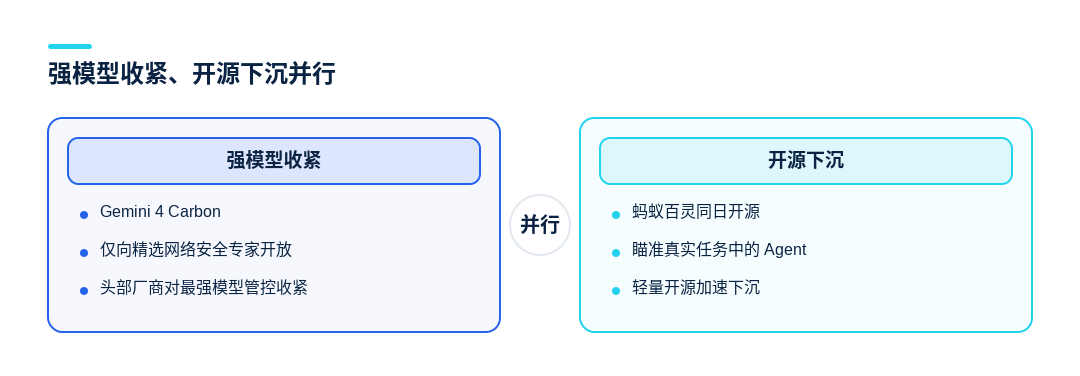
Google released the world model Genie 4 and frontier model Gemini 4 Carbon on the same day, with the latter available only to selected cybersecurity experts; Ant Ling open-sourced Ling-3.1-flash-1019 the same day, targeting Agents in real tasks. Leading vendors are tightening control over the most powerful models while lightweight open source accelerates downmarket; enterprise selection will face both 'unavailable' and 'cheaper' options.
Security Landscape: AI Scales Up Attack Capacity
South Korea uncovered its first large-scale AI-assisted hacking case, in which a single criminal group breached 90 organizations and stole 8.2 million records; counterfeit ChatGPT/Claude apps use legitimate signatures to spread malware; a high-risk UEFI firmware vulnerability is reported to affect most servers worldwide. We recommend putting AI application controls, firmware patching, and open-source supply chain patches on the same risk list, and completing a round of exposure checks this week.
Today at a Glance
- Today's Picks
- 8items
- Topic Groups
- 3groups
- Information Sources
- 9sources
- Azure Quarterly Revenue, First Disclosed
- 33.2100M USD
Market & Industry Watch
Microsoft First Discloses USD 33.2B in Azure Quarterly Revenue
Microsoft publicly disclosed Azure's quarterly revenue in dollar terms for the first time: USD 33.2 billion, a figure never previously disclosed, allowing the outside world to directly compare Azure's scale with market leader AWS for the first time. The timing suggests cloud and AI infrastructure have become core assets in Microsoft's earnings narrative. For enterprise decision-makers, as leading cloud providers enter head-to-head competition, the bargaining room in renewal negotiations, AI compute reservations, and multi-cloud strategies deserves reassessment.
Learn MoreOpenAI and ServiceNow Expand Enterprise Workflow Partnership
OpenAI and ServiceNow announced an expanded partnership: OpenAI's models and Agents will be available on the ServiceNow platform, while ServiceNow workflows will connect to ChatGPT and Codex. ServiceNow is a mainstream platform for IT services and process automation at large enterprises, and the partnership means AI Agents are moving from standalone tools into core business processes. Enterprises using ServiceNow should assess data permissions and workflow approval governance after Agent integration in advance, and include such capabilities in their next procurement evaluation.
Learn MoreAI Updates
Google Releases Genie 4 and Gemini 4 Carbon
Google released two new models at once: the world model Genie 4 is currently waitlist-only; its latest frontier model Gemini 4 Carbon is available only to selected cybersecurity experts, with media reports saying it outperforms Opus 5.5. Giving the most powerful model first to security researchers rather than opening it broadly shows that leading vendors are tightening controls over frontier-model misuse risks. Enterprises can watch the channel and pricing cadence after general availability; existing deployments need no adjustment for now.
Learn MoreAnt Group's Ling Open-Sources Ling-3.1-flash-1019
Ant Group's Ling large model open-sourced Ling-3.1-flash-1019 on October 28, aiming to enable Personal Agents to complete real tasks rather than just Q&A demos. Domestic lightweight models are iterating rapidly through open source, offering more low-cost options for enterprises to deploy agents privately. Enterprises planning internal AI assistants or automated workflows can include such open-source models in their selection comparison, with a focus on stability in real tasks. Related reading: more open-source project analysis in AI Radar (/ai-radar/opensource).
Learn MoreSecurity Incidents
High-Risk UEFI Firmware Vulnerability Affects Most Servers Worldwide
According to WIRED, a high-risk UEFI firmware vulnerability affects most servers worldwide: UEFI firmware is used by the vast majority of server vendors and data centers, and attackers can exploit the flaw to execute code at the earliest stage of system boot. The firmware layer sits below the operating system, making it difficult for conventional endpoint protection and vulnerability scanning to cover; remediation depends on vendor firmware updates and reboot windows. Enterprises should verify the firmware versions of servers in service and vendor security advisories as soon as possible, schedule firmware upgrades for critical assets in the nearest change window, and prioritize data centers and hosted environments.
Learn MoreSouth Korean Police Bust First Large-Scale AI-Assisted Hacking Case
South Korean police busted the country's first large-scale AI-assisted hacking case: suspects used AI to improve efficiency in breaching 90 organizations, stealing 8.2 million records, and threatening to disclose the stolen information to demand KRW 360 million in ransom. This is a typical case of AI significantly boosting attack capacity, and the ubiquitous attack surface formed by small and medium-sized organizations is especially hard to defend. For enterprises, the frequency of phishing, data theft, and ransomware attacks is expected to rise; data breach response plans and customer notification mechanisms should be rehearsed in advance for a larger impact scope.
Learn MoreCounterfeit ChatGPT/Claude Apps Use Legitimate Signatures to Spread Malware
Check Point research found that attackers are spreading malware through counterfeit ChatGPT and Claude desktop apps: the installers embed legitimately signed executables from OpenAI and Anthropic to load malicious code on Windows systems and bypass signature-trust-based detection. Employees installing AI tools on their own is becoming a new infection vector. We recommend adding AI desktop apps to software allowlists and endpoint admission controls, distributing them only through official channels, and conducting a review of installed third-party AI tools.
Learn MoreHigh-Risk Command Injection Vulnerability in npm Package systeminformation
The widely depended-on npm package systeminformation disclosed a high-risk vulnerability, CVE-2026-116576: on Windows, when the services() interface concatenates PowerShell commands, its default sanitization filters only ASCII quotes, and Unicode curly quotes can bypass the filter, leading to command injection. Many Node.js operations and monitoring projects depend on this package, giving the issue a broad impact. Enterprises should check dependency lists for affected versions and prioritize upgrades, especially for internet-exposed services.
Learn MoreFollow Zhaoxun
Get daily AI and Information Security insights. Contact us for security program needs.