
AI Analysis
Today's Highlights
AI is simultaneously intensifying capital inflows and attack efficiency: Anthropic is racing toward the largest IPO in history while Oracle expands multi-gigawatt-scale compute deployments; on the risk side, the high-severity Brotli vulnerability has been exploited in the wild, and South Korea’s first large-scale AI-assisted hacking case stole 8.2 million records. The most urgent decision today is to bring AI toolchains into enterprise asset management and threat models while accelerating remediation of high-risk components.
Market Trends: AI Capitalization Enters the Payoff Phase
Anthropic published a 335-page prospectus and is preparing what is being called the largest IPO by an AI company in history, with its 7 co-founders collectively holding 50.1% of the voting power. As leading vendors shift from fundraising races to profitability validation, model services will place greater emphasis on cost control and pricing discipline. When procuring their APIs and subscription services, enterprises should assess supplier operational stability.
Industry Trends: Cloud Compute Supply Diversifies Rapidly
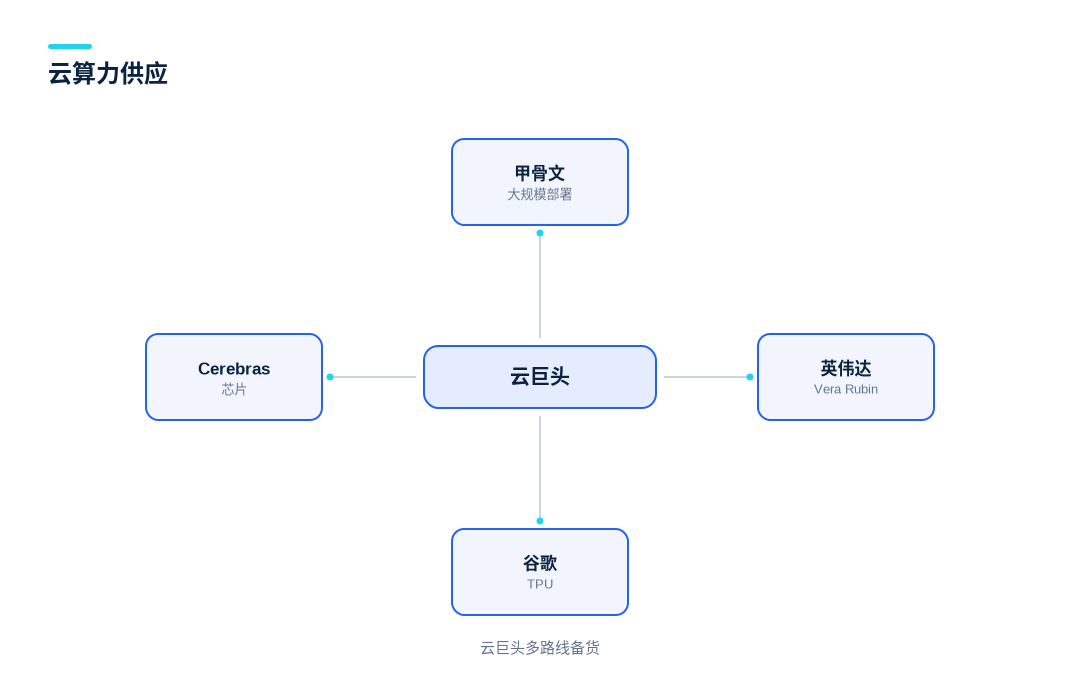
Oracle announced a large-scale deployment of NVIDIA’s latest Vera Rubin AI servers, spanning multiple gigawatts, while introducing Google TPUs and Cerebras chips. Hyperscalers are stocking multiple compute paths, which is expected to increase the supply elasticity of cloud AI compute and give enterprises greater vendor choice and pricing leverage in capacity planning and cloud procurement.
AI Updates: High-Capability Models Cut Both Ways
OpenAI released GPT-6.1 Terra with greater speed and lower cost. It received a Critical cybersecurity rating and can develop exploit programs. The model’s official security rating provides a clear signal: security teams can use it to improve detection and validation efficiency, while the barrier to attacks is also falling. Enterprise AI usage policies need to catch up promptly.
Security Landscape: Exploitation in the Wild and AI Abuse Advance Together
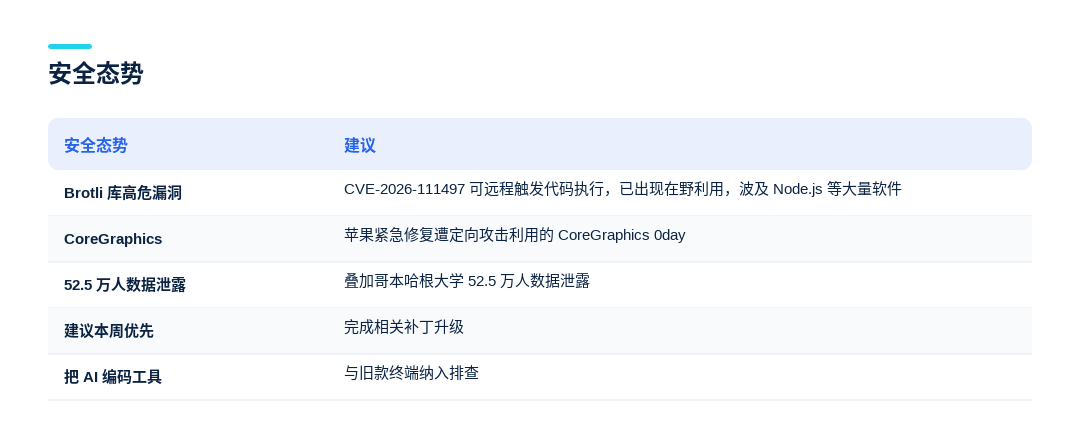
The Brotli library’s high-severity vulnerability CVE-2026-111497 enables remote code execution and has been exploited in the wild, affecting a wide range of software, including Node.js; Apple has urgently patched a CoreGraphics 0-day vulnerability exploited in targeted attacks. Together with the data breach affecting 525,000 people at the University of Copenhagen, these incidents make it urgent to prioritize relevant patching this week and review AI coding tools and older endpoints.
TODAY IN NUMBERS
At a Glance
- Today's Top Stories
- 8stories
- University of Copenhagen breach victims
- 52.5K
- Records stolen in South Korean AI hacking case
- 820K
- Anthropic prospectus length
- 335pages
Market and Industry Insights
Anthropic Releases 335-Page Prospectus for Record IPO
Anthropic has published a 335-page IPO prospectus that could become the largest IPO in the history of the AI industry, though the company has also been labeled the “most loss-making AI company ever.” Its 7 co-founders still collectively control 50.1% of the voting power. Making the prospectus public marks the point at which a leading AI company has formally entered the IPO race, shifting industry competition from fundraising scale to profitability validation. Two factors deserve enterprise decision-makers’ attention. First, valuations and investment at leading model vendors remain elevated, so price competition and product iteration in model services are likely to stay intense. Second, the founders’ concentrated voting power will affect corporate governance and long-term strategic stability; enterprises should include supplier stability in their assessment of enterprise services.
Learn MoreOracle Expands NVIDIA Partnership, Adds Google TPUs and Cerebras Chips
Oracle announced plans to deploy NVIDIA’s latest-generation Vera Rubin AI servers at multi-gigawatt scale, while introducing Google TPUs and Cerebras chips to diversify compute supply. Neither party disclosed the value of the transaction. By committing to NVIDIA while adding competing chips in bulk, the hyperscaler shows that cloud compute supply is moving from single-source dependence toward multiple parallel paths. Enterprise customers can expect a wider range of options and greater pricing flexibility for cloud AI compute. When planning compute for AI projects and procuring cloud services, they should evaluate diversified chip options while monitoring the performance and migration costs of each compute path.
Learn MoreSecurity Incidents
Brotli Library Critical RCE Vulnerability Exploited in the Wild
The Brotli compression library has a high-severity vulnerability, CVE-2026-111497, that allows remote exploitation for arbitrary code execution (RCE). Its impact extends far beyond Node.js, affecting numerous software and services that use the library, and exploitation has already been observed in the wild. When a foundational shared component like this is compromised, business systems across the entire supply chain are exposed, not just a single application. Enterprises should promptly inventory Brotli-dependent components and images across internal and external systems, upgrade them to the official patched versions, and watch perimeter defenses for exploitation traffic, prioritizing services exposed to the public internet.
Learn MoreApple Urgently Patches Exploited CoreGraphics 0-Day Vulnerability
Apple released the iOS 18.7.11 update to fix a CoreGraphics 0-day vulnerability that has been actively exploited in targeted attacks, affecting several older iPhone and iPad models. The combination of a 0-day and in-the-wild exploitation shows that attackers already have a mature exploit chain, making devices on outdated versions the most direct point of exposure. Enterprises should audit older iOS devices used by employees, especially those still running legacy versions that no longer receive automatic updates, and centrally push updates or enforce upgrades. In BYOD environments, MDM policies can verify OS versions and restrict noncompliant devices from accessing internal network resources.
Learn MoreUniversity of Copenhagen Cyberattack Exposes Data of 525,000 People
The University of Copenhagen suffered a cyberattack that exposed the personal data of approximately 525,000 people, including campus card PINs for about 20,000 students and staff. The affected systems have been temporarily shut down, and the incident has been reported to regulators. Educational institutions have long been prime targets for data-theft groups because of their large data volumes, aging systems, and complex account structures. This time, even physical access credentials were exposed, extending the impact to physical security. For organizations across all sectors, this is another reminder to apply tiered encryption and minimize retention of centrally stored identity and credential data, and to prepare breach response exercises and regulatory reporting procedures in advance rather than after an incident.
Learn MoreSouth Korea Uncovers First AI-Assisted Hacking Case: 8.2M Records from 90 Firms
South Korean police have cracked the country’s first large-scale AI-assisted hacking case. The suspects used AI to breach 90 organizations, steal 8.2 million records, and threaten to publish the stolen information in exchange for a ransom of 360 million won. This landmark case shows how AI can sharply lower the barrier to cyberattacks: large-scale intrusions that once required highly skilled teams can now be replicated by smaller groups using AI tools. Enterprises should reassess their threat models. Attack frequency and automation are both rising, and isolated point defenses and manual response times may struggle to keep pace. Strengthen anomalous-access monitoring, and rehearse response procedures for data extortion scenarios in advance.
Learn MoreWarning: Malicious Download Files Can Hijack AI Coding Tools
Security researchers warn that attackers can place malicious text files in locations such as the Downloads folder. When developers use AI coding tools such as Codex and Claude Code to process these files, malicious instructions can hijack tool behavior, alter configurations, install malicious programs, and enable persistent compromise and account token theft. As AI coding tools become widespread in enterprise R&D workflows, their privileged access to codebases and credentials is turning them into a new attack vector. Enterprises should bring AI coding tools under endpoint security controls: restrict their file and network access, review relevant configurations, and regularly rotate API tokens and access credentials.
Learn MoreStay Connected with Zhaoxun
Get daily updates on AI and Information Security. Contact us about your security needs.