
Daily Insights
Today’s Overview
Today’s signals boil down to one takeaway: AI investment and product development are accelerating, while the AI toolchain itself is becoming a new attack surface. For enterprises, the prerequisite for embracing AI-driven efficiency is to treat AI components and model providers as critical supply chains.
Market Trends: Capital Frenzy and Product Reshuffling Coexist
Anthropic filed its prospectus, reporting first-half revenue of 162.9 hundred million USD versus just 11.6 hundred million USD a year earlier, and is targeting the largest IPO in history. Meanwhile, Tencent’s QClaw shut down after an 188-day public beta, with 8 vendors and 10 product lines rapidly replaced as capabilities converge on general-purpose assistants. This means capital is flowing toward leading models and an application-layer shakeout has begun; vendor longevity should be included in selection evaluations.
AI Updates: Frequent Model Releases and Lower Inference Costs
OpenAI released GPT-6.1 Terra with API pricing cut in half, while Kimi K3.1 Pro expanded capacity and cut prices in a direct challenge to Claude Opus 5.5. Successive price cuts by leading models are opening a lower-cost window for enterprise adoption. Buyers should incorporate the new prices into budget calibration and procurement negotiations while avoiding dependence on a single provider.
Security Landscape: The AI Toolchain Becomes a New Attack Surface
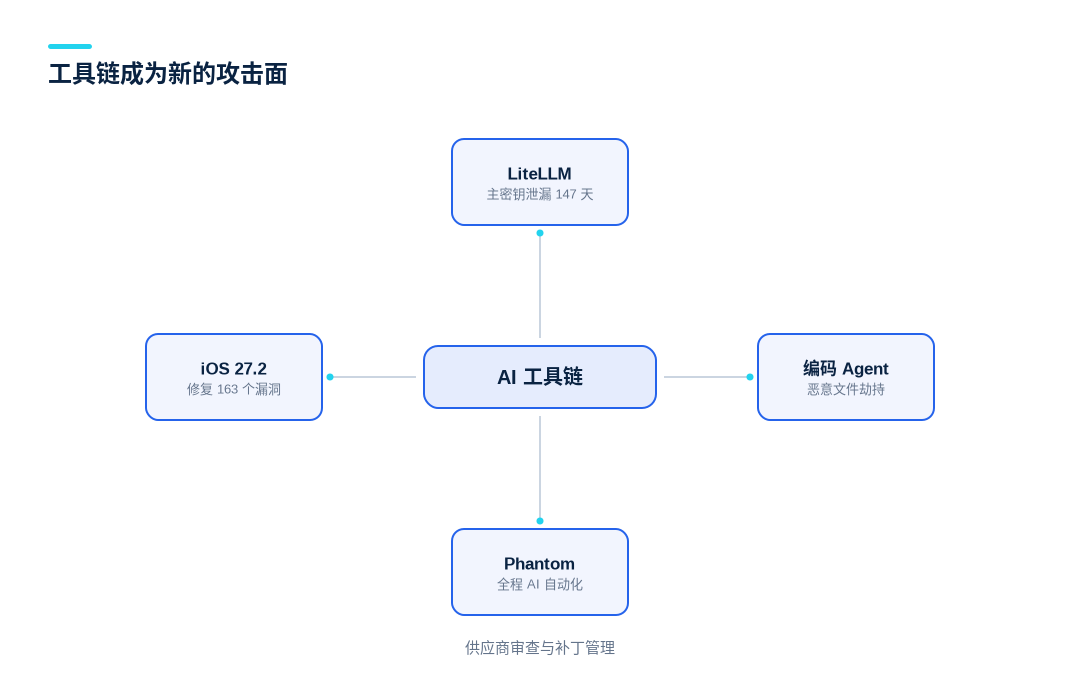
LiteLLM’s official release pipeline was hijacked, and its master key remained exposed for 147 days without revocation; the poisoned 1.107.0 release was distributed through PyPI. Coding agents such as Codex and Claude Code can be hijacked through malicious files in the Downloads folder, while the Phantom framework fully automates ransomware attacks. Together with iOS 27.2’s fixes for 163 vulnerabilities, this makes bringing AI tools into vendor reviews and patch management a priority this week.
Today at a Glance
- Today’s selected stories
- 8items
- topic groups
- 3groups
- LiteLLM master key remained unrevoked
- 147days
- fixed in a single iOS 27.2 release
- 163vulnerabilities
Capital and Market Landscape
Market and Industry Insights
Anthropic Files Prospectus, Targeting the Largest IPO Ever
Anthropic has publicly filed a prospectus with the U.S. Securities and Exchange Commission, plans to list on Nasdaq under ticker “ANT,” and is targeting the week of 11/16 for its debut. The generative-AI company, founded just 5 years ago, posted first-half revenue of 162.9 hundred million USD, versus 11.6 hundred million USD in the same period last year—growth of more than 10x in one year. TMTPost reports a first-half loss of 807 hundred million USD, while the market is discussing a valuation in the 2 trillion range; the IPO could set a record. For enterprise customers, leading model companies entering their capital payoff phase means the model supply landscape will consolidate further around a few well-capitalized vendors. We recommend adding supplier financial health and long-term service commitments to model procurement evaluations.
Learn MoreBig Tech AI Apps Reshuffle: Tencent QClaw Shuts After 188-Day Beta
TMTPost found that Tencent’s QClaw shut down after 188 days of public beta. Observations covering 8 major AI vendors and 10 product lines show that new products often last only a few weeks before being shut down, renamed, or merged. Standalone AI brands are exiting through rebranding, consolidation, or shutdown, while their capabilities rapidly migrate into each vendor’s general-purpose assistant. This means the AI application layer at major technology companies has entered a cycle of rapid experimentation and elimination, making the long-term availability of standalone AI tools uncertain. Enterprises that have built workflows around a standalone AI product should promptly confirm its status within the vendor’s roadmap and identify alternatives, prioritize general-purpose assistant platforms, and reduce migration costs if the vendor shuts down.
Learn MoreModels and Pricing
AI Updates
OpenAI Launches GPT-6.1 Terra: API Pricing Cut in Half
According to ifanr, OpenAI released the new GPT-6.1 Terra model, cutting API pricing in half and improving execution speed for computer-use tasks. The flagship model’s capability upgrade and substantial price cut mark a downward trend in inference costs, further lowering the barrier to using large models in customer service, document processing, and office automation. Buyers should recalculate costs based on current call volumes, use the new pricing as a benchmark in renewal and tender negotiations, and avoid signing long-term contracts at legacy prices. See AI Radar for the latest pricing and package comparisons.
Learn MoreKimi Launches K3.1 Pro, Challenging Opus 5.5
Moonshot AI released Kimi K3.1 Pro, directly challenging Anthropic’s flagship Claude Opus 5.5 by offering greater capacity at lower prices. In an official demo, Kimi Code continuously generated code for complex 3D scenes, with coding and Agent capabilities as the release’s main focus. When China-based frontier models deliver competitive flagship capabilities at lower prices, enterprises gain more negotiating leverage in model selection, making parallel testing and scenario-based procurement more cost-effective. We recommend adding domestic flagship models to the mandatory test list for the next evaluation and using measured performance rather than vendor claims to determine allocation ratios.
Learn MoreRisk and Action
Security Incidents
LiteLLM Master Key Leaked for 147 Days in Hijacked Release Pipeline
Attackers hijacked LiteLLM’s official release pipeline. Its master key remained exposed for 147 days without being revoked, and the 1.107.0 version distributed through the official PyPI channel was poisoned with an information-stealer trojan and a remote-access backdoor. The critical issue is that the attack surface has escalated from “injecting files into packages” to “hijacking official releases,” a stage not yet covered by most enterprise supply-chain defenses. Teams still using the component should immediately verify their installed version, roll back to 1.106.2, and rotate all related credentials. We also recommend including CI/CD and release-pipeline security in vendor assessment criteria.
Learn MoreMalicious Files Can Hijack Codex and Claude Code Coding Agents
Security research shows that a webpage can silently place a file containing malicious instructions in a user’s Downloads folder without their knowledge. When developers use AI coding agents such as OpenAI Codex or Claude Code to process that directory, the embedded instructions can induce the agent to alter configurations, install malicious programs, establish persistent access, and leak account tokens, ultimately leading to account takeover. This attack does not rely on a software vulnerability; it exploits agents’ default trust in local files, so defense should focus on permissions and operating procedures. We recommend setting directory allowlists for coding agents, preventing them from automatically executing unreviewed downloaded files, and monitoring developer endpoints for anomalous behavior.
Learn MorePhantom Framework Turns Ransomware into an AI-Automated Pipeline
According to 安全客, Russian hackers have launched the Phantom framework, embedding AI throughout the ransomware attack lifecycle: AI automatically writes ransom scripts, selects targets, and completes monetization, transforming operations that once relied on manual expertise and division of labor into an automated pipeline. The technical barrier and labor cost of attacks are falling significantly, and ransomware attempts against poorly protected enterprises are expected to increase. For enterprise leaders, the fundamentals still determine the scale of loss: regularly back up data offline and rehearse recovery, minimize the external attack surface, and train employees to recognize ransomware delivery methods. These controls should be revalidated to ensure they are genuinely in place.
Learn MoreiOS 27.2 Fixes 163 Security Vulnerabilities in One Update
Apple released iOS 27.2 and iPadOS 27.2 updates addressing 163 tracked vulnerabilities across Apple Intelligence, Mail privacy, browser engines, core system components, and other critical areas. Two fixes drew particular attention: an Apple Intelligence vulnerability that enabled remote attackers to access sensitive data, and a flaw in the “Hide My Email” feature that could expose users’ actual email addresses. The update also closed most iOS 27 vulnerabilities used to achieve complete jailbreaks. Given organizations’ large iPhone fleets and their often-sensitive business data, we recommend pushing upgrades centrally through MDM and including OS version compliance in endpoint baseline checks.
Learn MoreFollow Zhaoxun
Get daily updates on the latest developments in AI and Information Security. Contact us to discuss your security build-out needs.