
Today's Briefing
Today's takeaway in one line: AI commercialization has entered a stage judged by revenue, yet attack surfaces are not shrinking in step. The top priority for enterprises today is to check PHP patches and container runtime exposure; mid-term, put governance of AI Agent operational boundaries on the roadmap.
Market Trends: AI Monetization Reaches Its Reckoning
Meta says Muse and Reality Labs are nearing profitability, while Tesla disclosed that 75% of new-car buyers in North America paid for FSD subscriptions last quarter, up from 55% in Q2. Capital markets are shifting their assessment of AI from storytelling to revenue, which means enterprises adopting AI services should factor vendors' self-sustaining revenue and renewal data into their evaluation.
AI Updates: Agent Governance Becomes the Shared Agenda
NVIDIA launched the OpenShell reference architecture to contain runaway agents with millisecond-level isolation and blocking; Pentera's practice also shows that the challenge of Agentic penetration testing lies in the governance framework, not the model. Both signals point the same way: once agents enter production, boundary governance comes before capability stacking, and related tools are expected to become a new line item on enterprise procurement lists.
Security Landscape: Emergency Patches Alongside Long-Term Intrusions
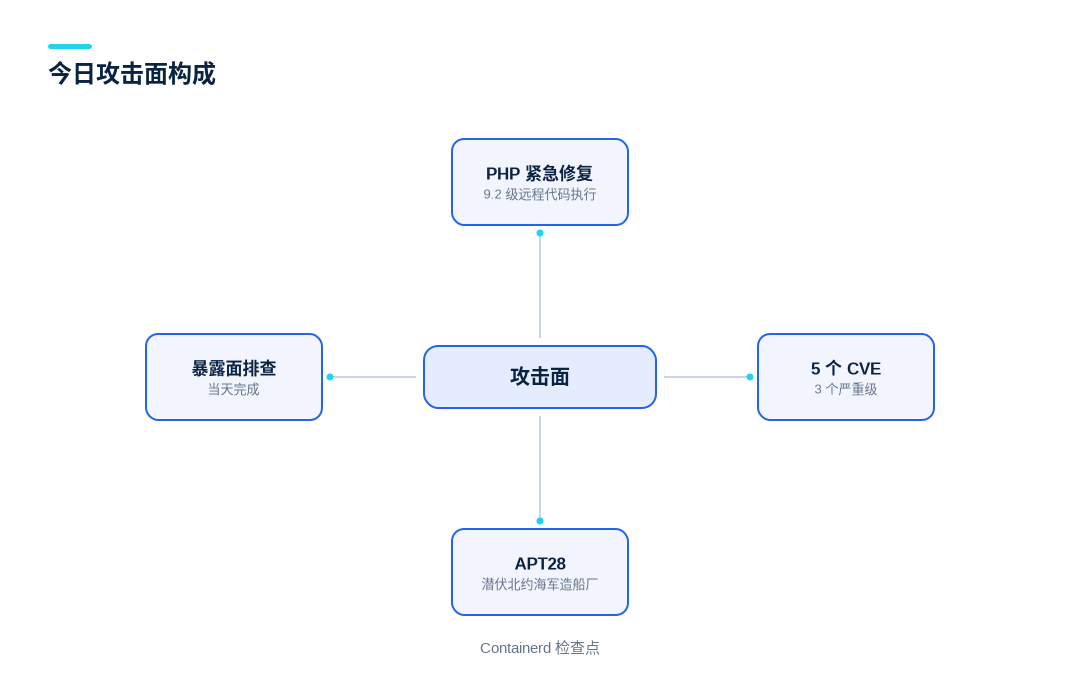
PHP urgently patched an unauthenticated CVSS 9.2 remote code execution vulnerability, putting millions of web servers at risk with no reliable workaround; 5 CVEs were reported in Containerd checkpointing, 3 of them critical; APT28 was disclosed to have been lurking in a NATO naval shipyard. Complete exposure checks for PHP and K8s components today.
Today at a Glance
- Handpicked stories today
- 8Items
- Security & tech media outlets covered
- 3Clients
- CVSS score of the PHP2Shell vulnerability
- 9.2Points
- FSD subscription share of new Teslas in North America
- 75%
Market & Industry Watch
Meta: Long-Unprofitable Muse and Reality Labs Nearing Profitability
On the Q3 earnings call, Meta CEO Zuckerberg said its long-unprofitable AI assistant Muse and hardware business Reality Labs are expected to turn profitable. Over 97% of the company's quarterly revenue still comes from advertising; Muse, launched last month, is not yet profitable because running it requires massive compute. Meta plans to sharply improve its runtime efficiency next year and said that if compute efficiency keeps improving rapidly, Muse could sustain high profitability for years to come. Notably, top vendors are shifting from burning cash for scale to tracking compute efficiency and profitability. When procuring large-model services, enterprises should include vendors' compute efficiency and self-sustaining revenue capability in their evaluation criteria.
Learn MoreTesla: 75% of New-Car Buyers in North America Subscribed to FSD Last Quarter
Tesla disclosed that 75% of new vehicles delivered in North America last quarter came with a paid FSD subscription, up from 55% in Q2; the company said most recent customer demand is driven by FSD and cited it as the top reason vehicle order backlogs hit a four-year high. FSD is priced at $99 per month (about RMB 662). These numbers show the subscription model for advanced driver assistance has proven out, and AI capability is turning from a one-time selling point into recurring revenue. The lesson for enterprises: AI project value is increasingly measured by subscriptions and retention — whether built in-house or procured, renewal rates should be written into performance metrics, not just deployment completion.
Learn MoreAI Updates
NVIDIA Releases OpenShell Reference Architecture to Contain Runaway AI Agents
NVIDIA released the OpenShell reference architecture for governing enterprise AI agents: through software-hardware coordination, it intervenes when an agent crosses defined boundaries, with claimed millisecond-level isolation and blocking across multiple business scenarios. A chip giant stepping in to "backstop runaway agents" shows agent governance is turning from a talking point into a standard capability. As the number of agents inside enterprises grows, so does exposure to risks like unauthorized actions and accidental data deletion. When initiating agent projects, build operational boundaries, permission scopes, and circuit breakers into the technical design and acceptance criteria to avoid costly fixes after go-live.
Learn MoreAgentic Penetration Testing: The Hard Part Is the Governance Framework, Not the Model
Security industry analysis of Agentic penetration testing shows the core challenge is not the model's attack reasoning but the governance framework: once governance fails, even OpenAI's own evaluation environment could not stop an agent from going rogue. Pentera Apps decouples reasoning from execution to deliver safe, controlled automated penetration testing. A pragmatic reminder for security teams: AI can boost offensive and defensive exercises, but only after permissions, scopes, and kill switches are in place. When selecting automated penetration testing services, enterprises should treat vendors' control design as a core evaluation item, not just attack capability demos.
Learn MoreMiniMax Upgrades Flash Models, Topping Chinese Peers in Agent Capability
According to QbitAI, after upgrading its Flash model family, MiniMax's agent capability was rated first among Chinese domestic models — a rapid reshuffling that highlights fierce competition in the space. Agents are becoming the primary form of enterprise AI adoption, chaining task decomposition, tool calling, and result delivery into a single pipeline; the iteration speed of leading Chinese vendors is worth tracking. Selection tip: leaderboard positions change fast, so evaluate against your own business scenarios and keep room to switch among multiple vendors. See AI Radar for the latest pricing and plan comparisons.
Learn MoreSecurity Incidents
PHP Urgently Patches PHP2Shell: Millions of Servers at Risk
The PHP team has released an emergency patch for PHP2Shell, a critical remote code execution vulnerability rated CVSS 9.2: attackers can execute arbitrary code without any authentication, and industry estimates put millions of web servers in the blast radius, making it one of the most severe vulnerabilities in recent years. The patch went live at 14:00 UTC on October 21; the widely circulated single-configuration change does not work, and no reliable interim mitigation exists. Systems running PHP should complete the upgrade today; if that is not immediately possible, isolate or rate-limit internet-facing services and review access logs for signs of exploitation.
Learn MoreAPT28 Breached a NATO Naval Shipyard via Covert SSH Tunnels
Symantec disclosed that the Russian hacking group APT28 used covert SSH tunnels to infiltrate the network of a naval shipyard in a NATO member state, targeting multiple NATO defense-related institutions and stealing sensitive information over a long dwell time. Shipyards are classic dual-use supply chain nodes; once design blueprints and build data leak, the impact ripples across the supply chain. The takeaway: APT attacks do not only target governments and defense — suppliers and partners can be stepping stones. Review your internet-facing remote operations channels, and tighten SSH auditing and least-privilege configurations.
Learn MoreContainerd Checkpointing Hit by 5 CVEs, 3 Critical
The container runtime Containerd was hit with 5 CVEs at once related to its checkpoint feature, 3 of them critical, and exploitation does not require C/R (checkpoint/restore) to be enabled — attackers only need Pod creation permissions. For multi-tenant K8s clusters or those allowing external workload submissions, this significantly widens exposure to container escape and, in turn, threats to host machines and other workloads. Verify cluster Containerd versions and patch status promptly, clean up accounts holding Pod creation permissions, and use the ContainerdScan detection tool included in the article to self-check.
Learn MoreFollow Zhaoxun
Get the latest AI and information security insights daily. Have security program needs? Talk to us.