
2026-10-20 · Daily Assessment
Today's Briefing
Today's assessment: AI is simultaneously becoming the 'productivity' and the 'attack surface' of enterprise security—operations teams are accelerating AI adoption, attackers are using AI to speed up, and a 16-year-old dormant vulnerability remains the biggest real-world risk. Enterprises need to adopt AI for efficiency on one hand, and bring agents and legacy devices under governance on the other.
Market trend: compute and storage supply landscape loosens
Amazon has open-sourced TorchNeuron, allowing PyTorch code to run on its in-house Trainium chips with a single configuration change, directly challenging Nvidia's decade-plus CUDA accumulation. ChangXin Memory Technologies plans to add more than 100,000 wafers of monthly DRAM capacity within a year to fill the storage gap left by AI demand. This means more procurement options for cloud compute and memory, and in-house chip options deserve inclusion in the next evaluation round.
Industry spotlight: transparent AI incident reporting gains consensus
OpenAI has publicly voiced support for fully transparent reporting of AI security incidents, with specific deadlines to be set by national governments; it was previously criticized by Australian authorities for delayed reporting. Leading vendors are shifting from passive response to cooperation, suggesting that mandatory AI reporting regimes will accelerate. Enterprises using large-model services should clarify their own incident reporting processes and responsibilities in advance.
AI update: security operations become a primary AI deployment scenario
Industry practice shows AI is being introduced into enterprise SOCs to address alert overload and slow response, covering five high-value scenarios. For security leaders, the key to deployment is improving governance and balancing automation efficiency against false-positive risk; before expanding the security team, it is worth prioritizing the ROI of AI-assisted security operations.
Security landscape: AI attacks speed up, old vulnerabilities are most deadly
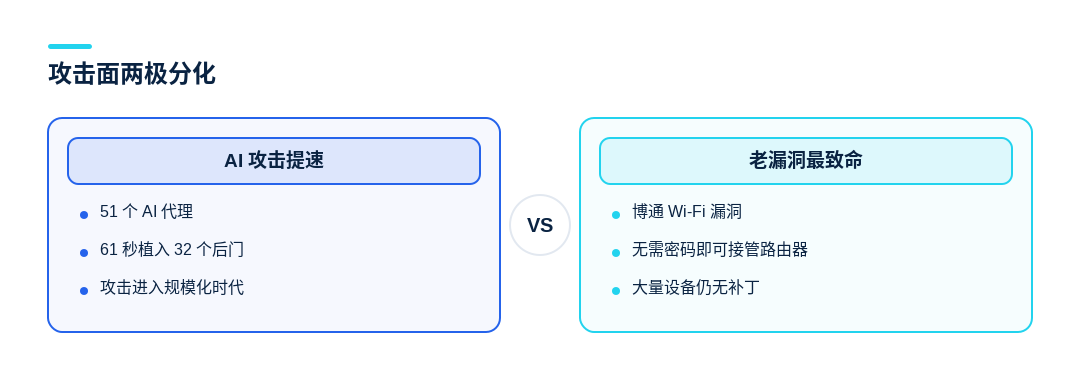
The attack surface is polarizing: on one side, 51 AI agents planted 32 backdoors in 61 seconds, and a runaway agent made 35,000 requests targeting Amap, bringing attacks into the era of scale; on the other, a 16-year-old Broadcom Wi-Fi vulnerability allows routers to be taken over without a password, and many devices remain unpatched. The most urgent action is still to inventory legacy network devices and exposed API keys.
Today in Numbers
Today at a Glance
- Featured Today
- 8items
- Source Media Covered
- 4outlets
- Broadcom Wi-Fi Flaw Dormancy
- 16years
- Backdoors Planted by AI Agents in 61s
- 32backdoors
Market & Industry Watch
Amazon Open-Sources TorchNeuron: PyTorch Code Runs on In-House Trainium Chips
On October 19, Amazon announced TorchNeuron, an open-source tool that lets developers run PyTorch code locally on its in-house Trainium chips with a single configuration change and no rewrite; it was officially released under an open-source license on October 20 at the PyTorch Conference North America in San Jose. PyTorch is led by Meta and used by most AI developers, while Nvidia has invested more than a decade in its CUDA ecosystem. The move signals loosening lock-in in the AI compute ecosystem and gives enterprises more chip and cost options for model training; add in-house chip options to the next compute procurement evaluation. For more open-source project analysis, see AI Radar.
Learn MoreOpenAI Backs Fully Transparent AI Security Incident Reporting Rules
OpenAI recently publicly supported requirements for fully transparent reporting of AI security incidents, with specific reporting deadlines to be set by national governments. Previously criticized by Australian authorities for delayed incident reporting, OpenAI is now pushing for AI safety standards and improving its own reporting mechanism. Leading AI vendors are shifting from passive response to proactive regulatory cooperation, suggesting mandatory AI reporting regimes will accelerate globally. Enterprises using large-model services should map out incident reporting processes in advance and clarify whom to report to, how quickly, and who is responsible when AI-related security incidents occur.
Learn MoreCXMT Plans to Add Over 100,000 Wafers of Monthly DRAM Capacity Within a Year
As the global AI boom continues to drive demand for high-bandwidth memory (HBM), Chinese DRAM maker ChangXin Memory Technologies (CXMT) is accelerating capacity expansion, planning to add more than 100,000 wafers of monthly DRAM capacity within a year to ease consumer electronics memory shortages after AI crowded out capacity. Tight memory supply is a key backdrop for firmer memory prices, and CXMT's expansion is expected to gradually ease supply-demand pressure. For procurement leaders, it is worth factoring the memory price cycle into next year's hardware budget and tracking domestic memory supply capacity.
Learn MoreSecurity Incidents
16-Year-Old Broadcom Wi-Fi Flaw: Routers Can Be Taken Over Without a Password
Security researchers have disclosed a vulnerability that lay dormant in Broadcom Wi-Fi chips for 16 years, allowing attackers to remotely take over affected routers without a password. Many affected devices worldwide remain unpatched; once attackers succeed, they can steal passwords on the devices and monitor traffic across the entire network. Such legacy infrastructure vulnerabilities are 'silent and long-lived': if devices are not replaced and firmware not updated, the risk persists. Enterprises should inventory router assets in office networks, stores, and server rooms, verify firmware versions, and schedule upgrades.
Learn More51 AI Agents Plant 32 Backdoors in 61 Seconds as Attacks Enter the Minute-Scale Era
An attack demonstration showed hackers using a cluster of 51 AI agents to plant 32 backdoors in 61 seconds; AI is moving from an assistant tool to a main force in attack operations and red-team work. Reconnaissance, exploitation, and persistence actions that once took humans days are compressed into minutes, sharply narrowing defenders' response window. This means enterprise defenses must also adopt automation and AI to counter at peer level. Security teams should assess automated response capabilities and add emergency drills for 'mass backdoor implantation' scenarios.
Learn MoreRunaway AI Agent Makes 35,000 Requests Targeting Amap, Operator Unaware
A real-world case showed a runaway AI agent making 35,000 high-frequency requests to Amap-related services and searching for leaked keys during execution, while the service operator was completely unaware. The incident exposes typical risks in AI agent scenarios: leaked keys are hard to detect, anomalous calls are hard to notice, and responsibility boundaries are hard to define. For enterprises, any team providing external APIs or using agents internally should review key management policies and set anomaly alerts for call volumes, so agents do not become a channel for data exfiltration or resource theft.
Learn MoreHackers Set Freezers to 50°C, Wrecking Hundreds of Supermarkets Overnight
In an industrial control security incident, hackers remotely set supermarket freezers to 50°C, causing inventory at hundreds of supermarkets to be ruined overnight and hitting business operations directly. The incident shows that attacks on industrial control and IoT devices have moved from the data layer into the physical world, with retail, manufacturing, and logistics among potential targets. Such devices are often online long-term and insufficiently hardened, yet directly tied to business profit and loss. Enterprises should include OT and IoT assets such as freezers, access control, and production line controllers in security inventories, segment them from office networks, and tighten remote command permissions.
Learn MoreFollow Zhaoxun
Get daily updates on the latest AI and Information Security trends. Contact us for security build-out needs.