
Today's Overview
The key takeaway today: evidence of model capability is moving from benchmark leaderboards to real-world hard tasks, with labs using production data and math-level problems to demonstrate their strength. On the new-model front, Kling and the open-source Inkling 2 Mini launched on the same day, advancing image resolution and on-device deployment respectively and giving enterprises new reference points for model selection.
New Models: 8K Images and On-Device Models for Laptops
New models advanced in two directions within a single day. Kling Image 4.0 focuses on native 8K and text rendering, with its scores on two Artificial Analysis leaderboards rising by more than 225 Elo over the previous generation; Thinking Machines Lab open-sourced Inkling 2 Mini, with 26.4B parameters but only 3.4B active, enabling local operation on a Mac with 32GB of memory.
Capabilities and Evaluations: Doubling Times in Months
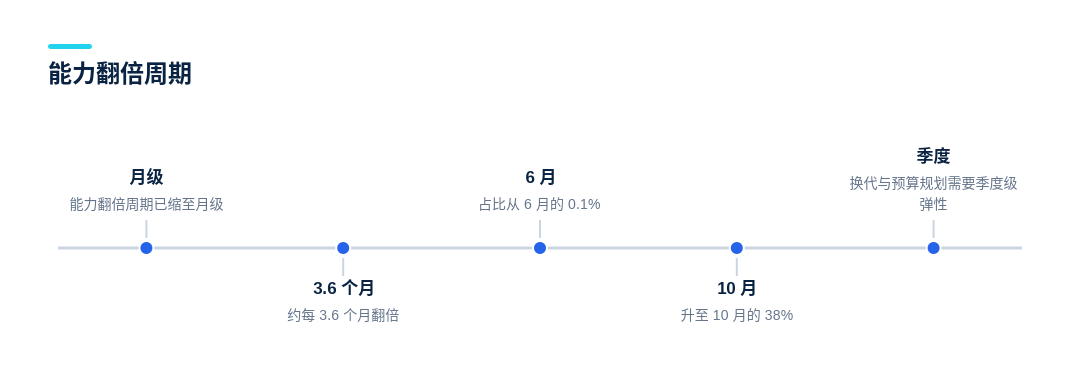
The capability-doubling cycle has fallen to a monthly cadence. METR reports that, as of Opus 5.5 and GPT-6 Astra, the duration models can complete tasks continuously doubles roughly every 3.6 months; Runway production data supports this trend, with agents' share of merged PRs rising from 0.1% in June to 38% in October, while AI-only approvals show a lower rollback rate than human approvals. Model transitions and budget planning require quarterly flexibility.
Pricing and Open Source: Per-Image Costs Drop to the Cent Level
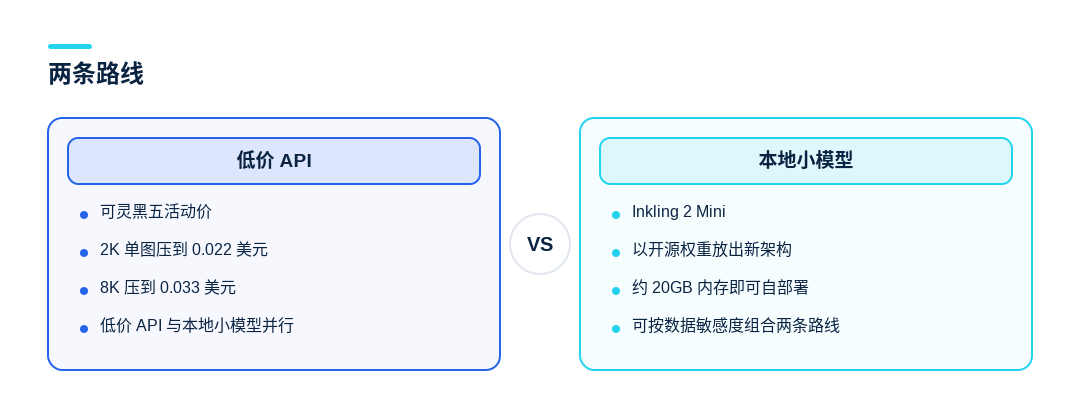
API usage and deployment costs are falling in tandem. Kling's Black Friday promotion cuts 2K images to USD 0.022 and native 8K images to USD 0.033; Inkling 2 Mini has released its new architecture as open-source weights, enabling self-deployment with about 20GB of memory. Low-cost APIs and local small models provide complementary options that can be combined based on data sensitivity.
Today's At a Glance
- Featured stories today
- 6stories
- New models released
- 2models
- Share of merged PRs driven by Runway agents
- 38%
- METR-measured capability doubling period
- 3.6months
New Model Releases
Kling Releases Image 4.0 with Native 8K
Kling has launched the Image 4.0 image-generation model, supporting native 8K output, consistency across image sets, and advanced text rendering. According to Artificial Analysis, it ranks 7th for text-to-image and 6th for image editing, with both scores improving by more than 225 Elo over 3.0 Omni. Black Friday promotional pricing starts at USD 0.022 per 2K image and USD 0.033 per native 8K image.
Per-image costs have entered the cent range, making marketing and design asset production ready for pilot evaluation. See AI Radar (/ai-radar/pricing) for the latest vendor pricing and plan comparisons.
Capability Evaluations and Benchmarks
METR: Model Task Horizons Double Roughly Every 3.6 Months
METR released an update to its capability measurements covering models through Opus 5.5 and GPT-6 Astra: on TH1.1 and TH2 tasks, the duration models can complete continuously roughly doubles every 3.6 months, while the verifiable subset doubles even faster, in about 1.65 months. The organization also cautions that these capabilities are becoming increasingly difficult to measure.
With capability doubling measured in months, procurement and budgets should reserve quarterly model-switching windows rather than lock in for a full year.
Runway: Agents Drive 38% of Merged PRs
Runway disclosed data on agent participation in software delivery: agents drove 38% of merged PRs in October, up from just 0.1% in June; median wait for initial PR approval fell from over 2 hours to about 5 minutes; and PRs approved solely by AI had a rollback rate of roughly one in a thousand, below the approximately 1/200 rate for human-approved PRs.
Agent output now has a measurable benchmark, enabling R&D teams to run limited pilots and set rollback rates as an adoption threshold.
Frontier Capability Breakthroughs
MiniMax MIM Reports Multiple Practical Cryptanalytic Breakthroughs
MiniMax's research team reported that its internal research model, MIM, delivered the first practical cryptanalytic breaks for multiple schemes spanning NIST candidate algorithms, peer-reviewed designs, and public challenge benchmarks. These schemes previously had only theoretical attack paths; some attacks are now executable, and the validation traces have been open-sourced alongside the paper.
With practical cryptanalysis capabilities, cryptographic asset risk assessment cycles should be shortened, and security teams should follow the open-source validation traces.
Claude's Riemann Hypothesis Proof Claim Awaiting Verification
Anthropic mathematician Levent Alpöge announced a collaboration with Claude that produced a proof of the Riemann hypothesis. No paper was provided; instead, the team released 14 archives containing 175187 Lean files and approximately 17.37 million lines of formal code. The result has not yet been independently verified and should be treated as a claim pending proof.
If peer-reviewed, the result would redefine the frontier of model mathematical reasoning. For now, observation is advised and model selection should not be adjusted on this basis.
Zhaoxun Focus
Receive daily updates on the latest developments in AI and Information Security. Contact us to discuss your security transformation needs.