
Today's Briefing
Today’s theme is “opening up”: Tencent Hunyuan has released the Hy4 flash weights to the community, while Google has rolled out Gemini 4 Hydrogen across Google Search worldwide. Model capabilities are reaching enterprises directly through open-source releases and deployment options. Meanwhile, evaluation videos and live feedback for GPT-6.2 Sol/Astra differ, so findings from the launch week may quickly become outdated. Two takeaways for decision-makers: there is now another open-source, long-context option that can be self-hosted, and model selection should be validated through testing of the current release.
New Models: Open-Source and Deployment Access Expand on the Same Day
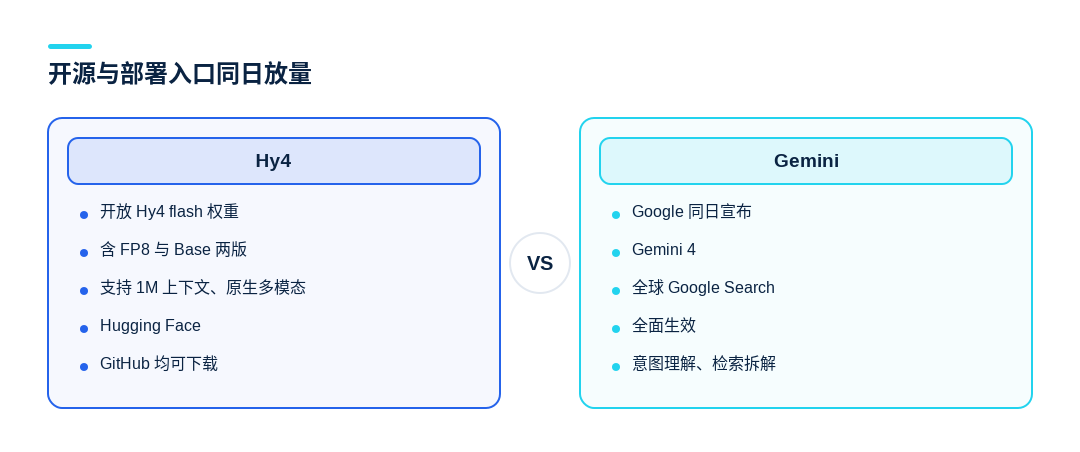
Tencent Hunyuan has released the Hy4 flash weights in FP8 and Base versions: 224B total parameters and 12B active parameters, with support for a 1M context and native multimodality. They can be downloaded from Hugging Face and GitHub, and the official team has also teased the upcoming Hy4. On the same day, Google announced that Gemini 4 Hydrogen is now live across Google Search worldwide, calling it the largest model upgrade for the product to date, with improvements in intent understanding, query fan-out, and multilingual performance. The combination of FP8 and a 1M context provides a new reference point for private long-document deployments.
Capabilities and Evaluations: User Feedback and Benchmark Scores Are Out of Sync
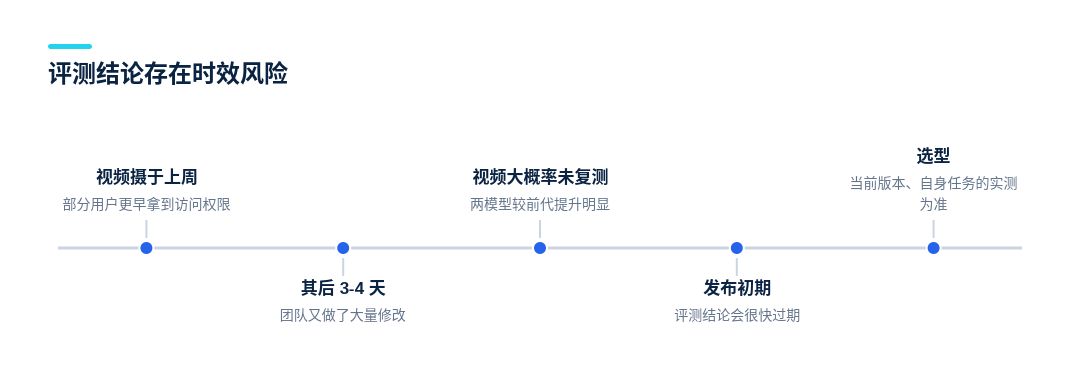
GPT-6.2 Astra and Sol are now available across ChatGPT, Codex, and API. Third-party testing suggests Astra is designed for extreme cost savings but has uneven capabilities, with limited improvement in conversational readability. Tibo, a member of the Codex team, responded to the discrepancy in evaluation results: the video was filmed the previous week, and the team made extensive changes over the following 3-4 days. Some users received access earlier, and the video was most likely not retested. He acknowledged that both models improve significantly over their predecessors but are not perfect. This means evaluation findings from the early launch period can quickly become outdated, and model selection should be based on testing the current release against your own workloads.
Today at a Glance
- Hy4 flash total parameters
- 224B
- Hy4 flash active parameters
- 12B
- Hy4 flash context window
- 1M
- Today’s featured model updates
- 4items
New Model Releases
Tencent Hunyuan Releases Hy4 flash Weights: 224B Parameters, 1M Context
Tencent Hunyuan has announced the release of Hy4 flash weights, with two download options: an FP8 quantized version and a Base model version. The model has 224B total parameters, activates only 12B per step, supports a 1M context window, and features native multimodal capabilities. The company positions it as an efficient option for everyday productivity. It is licensed under Tencent Hy License, with weights now available on Hugging Face and GitHub; the full Hy4 release is also forthcoming.
FP8 weights with a 1M context can be directly included in private deployment evaluations, making them suitable for teams whose data cannot leave their environment. For more open-source project coverage, see [AI Radar](/ai-radar/opensource).
Gemini 4 Hydrogen Rolls Out Across Google Search Worldwide
Google announced that Gemini 4 Hydrogen is now live for users worldwide in Google Search, calling it the largest model upgrade in the product’s history. The changes focus on four areas: more accurate understanding of user intent, smarter query fan-out and external-link organization, response formats that adapt to the type of question, and stronger multilingual performance. Google Search’s default answer quality now runs on the new model.
Businesses dependent on search traffic should monitor changes in citations, external links, and visibility distribution after the upgrade.
Capabilities and Evaluations
Hands-On Evaluation of GPT-6.2 Astra: Cost-Saving Focus but Uneven Capabilities
OpenAI’s two new GPT-6.2 models, Astra and Sol, have launched simultaneously across ChatGPT, Codex, and API. After hands-on testing, the WeChat account “数字生命卡兹克” concluded that Astra drives inference costs down to an extremely low level, clearly prioritizing cost savings, but its capability profile is severely uneven and conversational readability has not improved. Define task boundaries before scaling deployment.
Cost-sensitive use cases with clear task boundaries can try Astra to reduce costs; interaction-heavy scenarios should be tested for readability before switching.
Codex Team Addresses Gap Between 6.2 Evaluation Video and Live Feedback
Asked about the mismatch between the 6.2 Sol/Astra evaluation video and live feedback, Tibo, a member of the OpenAI Codex team, explained that the video was filmed a week earlier and that the team made extensive changes over the following 3-4 days. Some viewers also received access earlier, and the video was most likely not retested afterward. He said both models show marked improvements over the previous GPT generation but are not perfect, and that future iterations will refine model taste and the user experience.
Evaluation findings can quickly become outdated, so model selection should be validated by retesting the current release on your own tasks.
Follow Zhaoxun
Get daily updates on the latest AI and Information Security developments. Contact us to discuss your security build-out needs.