
Today’s Overview
Enterprise AI competition is extending beyond model capabilities to data boundaries, deployment efficiency, and channel control. Benchmark leadership, private inference, ternary compression, agent experimentation, and shopping-agent negotiations are all emerging at once, requiring enterprises to assess cost, privacy, engineering governance, and platform rules within one selection framework.
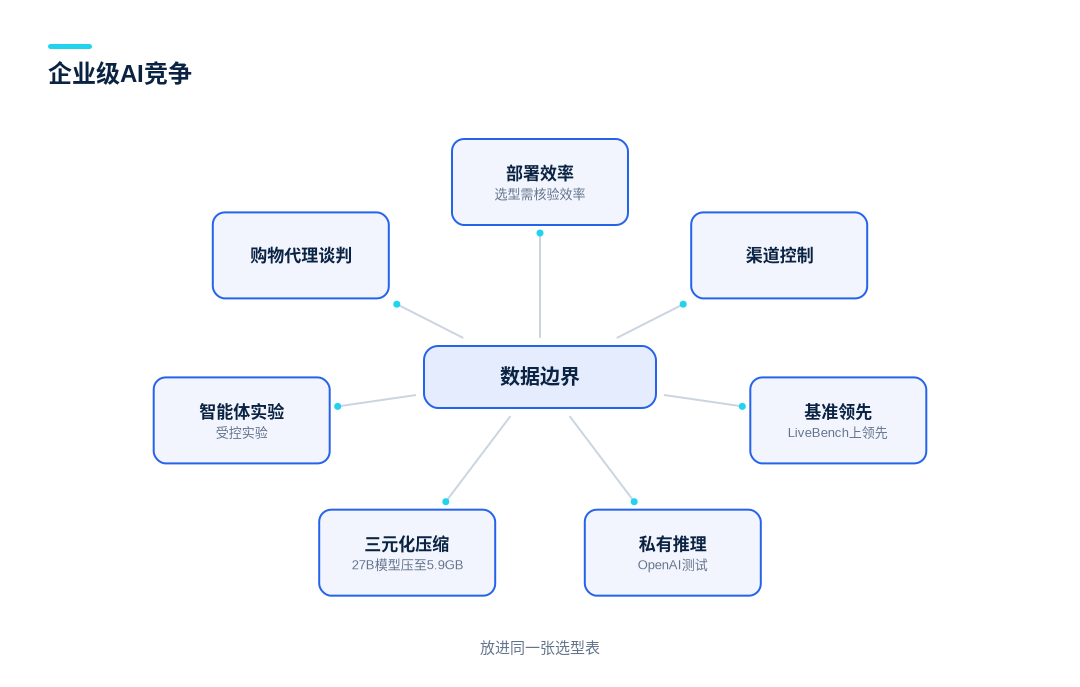
Models and Products: Performance and Data Boundaries Advance
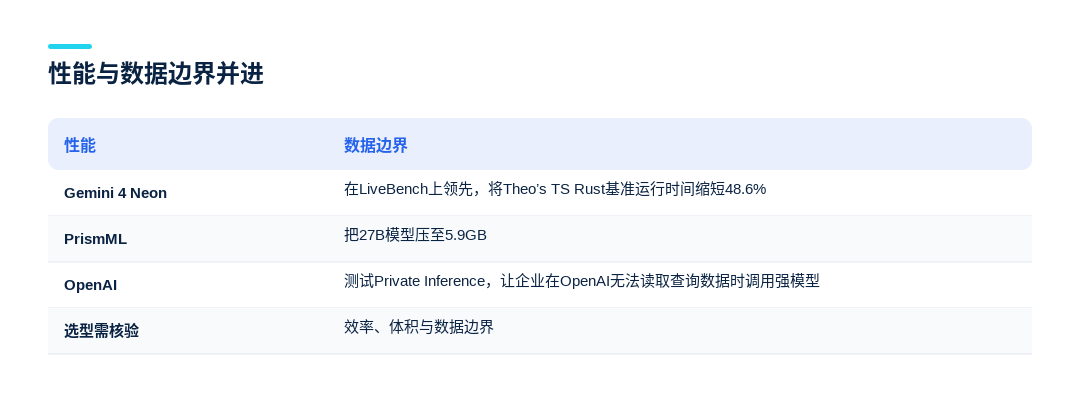
Gemini 4 Neon leads LiveBench and cuts Theo's TS Rust benchmark runtime by 48.6%; PrismML compresses a 27B model to 5.9GB. OpenAI is testing Private Inference, allowing enterprises to access its most capable models without OpenAI being able to read query data. Selection decisions must verify efficiency, model size, and data boundaries.
Research Frontiers: Experiment Automation Meets Deployment Barriers
Anthropic’s study of nearly 300 AI deployments at 58 U.S. companies found that almost one in five projects had yet to deliver business value; approval burdens, internal bottlenecks, and employee resistance matter more than tool proficiency. Google DeepMind has enabled AI agents to control some compute resources for Gemini experiments, but the research lead says recursive self-improvement remains far away, making agents better suited to controlled experimentation today.
Industry and Regulation: Commercialization Stalled over Search and Revenue Sharing
Amazon and Meta are discussing the return of Meta’s shopping agent Muse to Amazon’s online store; the agent was removed from the platform in September, and the two sides have yet to agree on ad revenue sharing or control of search results. For retailers and brands, competition for AI shopping entry points depends not only on agent capabilities, but also on platform traffic and commercial rules, so adopters should allow for rule changes and bargaining leverage.
Today’s Highlights
- Reduction in Theo's TS Rust benchmark runtime
- 48.6%
- Ternary Bonsai 2.5 compressed size
- 5.9GB
- Ternary Bonsai 2.5 parameter count
- 27B
- U.S. companies covered by Anthropic study
- 58companies
Models and Products
Gemini 4 Neon Returns to the Frontier
In its November 24 AI briefing, Latent Space said Gemini 4 Neon surpassed Astra and Fable on LiveBench and cut Theo's TS Rust benchmark runtime by 48.6%. The report characterized Neon as a sign of GDM’s return as a frontier lab, citing two benchmark results. The material provides no pricing, context length, or details on model availability.
Validate benchmark gains on your workloads; compare vendor plans in AI Radar.
OpenAI Tests Private Inference for Stronger Data Isolation
The Decoder reports that OpenAI is testing a feature called “Private Inference,” allowing enterprises to run queries with its most capable models while OpenAI cannot access the query data. The design turns the question of whether sensitive workloads can be handled by an external model into an explicit vendor commitment on data-access boundaries. The material does not specify the general availability timeline, pricing, or scope of support.
Include it in vendor reviews; define data access, retention, and audit boundaries.
Ternary Bonsai 2.5: 27B Model Compressed to 5.9GB
The Decoder reports that PrismML released Ternary Bonsai 2.5 27B, a new version of its aggressively compressed language model. The key figures are a 54GB original model and a 5.9GB release after restricting each weight to three possible values. The item focuses on model size and weight quantization, but does not explain changes in accuracy, hardware compatibility, or licensing terms.
Validate accuracy, throughput, and memory use on target tasks before deployment.
Research and Deployment
Anthropic: Nearly One in Five Deployments Fail to Deliver Value
The Decoder reports that Anthropic studied nearly 300 AI deployments across 58 U.S. companies and found that almost one in five projects had yet to deliver business value. The report identifies burdensome approval processes, internal workflow bottlenecks, and employee resistance—not employees’ inability to use the tools—as the main obstacles. The analysis attributes deployment difficulties more to organizational processes and adoption resistance than to model usability alone.
Accept deployments on business outcomes; fund governance for approvals and adoption barriers.
DeepMind Lets AI Agents Run Select Gemini Experiments
The Decoder reports that Google DeepMind is using AI agents to autonomously run experiments for upcoming Gemini models, with the agents controlling some compute resources. Research lead Koray Kavukcuoglu says the lab remains far from recursive self-improvement. The report frames the current progress as agents taking on selected experimental work, rather than achieving a closed-loop model development process.
Govern experiment permissions, result reviews, and stop conditions before adopting agentic R&D.
Industry Ecosystem
Amazon and Meta Negotiate to Restore Shopping Agent Muse
The Decoder reports that Amazon and Meta are negotiating to allow Meta’s AI shopping agent Muse back into Amazon’s online store. Amazon removed Muse from the platform in September, and negotiations remain stalled over advertising revenue sharing and who controls search results. The report indicates that the platform and agent provider still have not agreed on commercial rules and control of the shopping entry point.
Assess AI shopping traffic, revenue sharing, and control over search results.
Follow Zhaoxun
Get daily updates on the latest AI and Information Security developments, and contact us if you need help building your security program.