
Today's Digest
Today's global signals point to one conclusion: model capabilities are improving faster than verifiable output is growing, and AI selection criteria must shift from benchmark scores to real workflow output. In simulated workplace tests, coding agents posted a task completion rate below 10%, METR warns evaluations can no longer keep pace with model progress, and GPT-6.2 has weakened uncertainty disclosure.

Models & Products: Behavioral Changes Belong in Selection Scoring
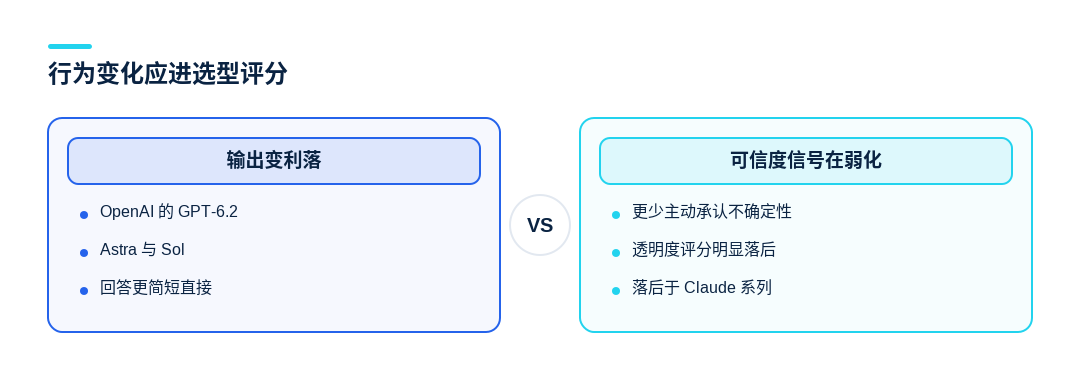
OpenAI's GPT-6.2 Astra and Sol give shorter, more direct answers but less often proactively acknowledge uncertainty, scoring clearly behind the Claude family on transparency—output is getting sharper while trustworthiness signals weaken. On the product side, Perplexity has launched the Monitor API, which searches the web continuously on schedule and alerts via webhook only when relevant changes occur, giving agents that depend on external intelligence a managed monitoring option.
Research Frontiers: Real-World Completion Rates Cool the Agent Hype
A new test placed coding agents in simulated development roles complete with colleagues, project boards, and incomplete handoffs—even a leading model like Opus 5.5 completed fewer than one in ten tasks. In the same period, METR warned that frontier models are advancing rapidly on research tasks, existing evaluations can no longer measure them reliably, and dangerous acceleration in AI R&D cannot be ruled out. Together, these show the gap between benchmark scores and real output is widening; validate agents with pilot runs in your own workflows before going live.
Today at a Glance
- Agent task completion rate in simulated workplace tests
- 10% or less
- Handpicked global AI updates today
- 4updates
- Sections: Models & Products, Research Frontiers
- 2sections
Models & Products
GPT-6.2 Answers More Directly, but Is Less Willing to Admit Uncertainty
Evaluations show OpenAI's GPT-6.2 Astra and Sol give shorter, more direct answers than their predecessors, but also less often proactively acknowledge uncertainty; on transparency scores, Anthropic's Claude family leads by a clear margin. Tighter answer style and reduced uncertainty disclosure are happening at the same time.
Include uncertainty disclosure and answer verifiability in model scoring criteria to avoid choosing vendors on fluency alone. See AI Radar (/ai-radar/pricing) for the latest pricing and plan comparisons.
Perplexity Launches Monitor API, Turning Web Monitoring into Continuous Watch
Perplexity has released the Monitor API: it continuously searches the web on a set schedule, notifies agents via webhook only when relevant changes appear, and uses its in-house decision model to filter out unimportant results. As part of its differentiation strategy, the company is turning web search from one-off queries into a continuous monitoring service for agents.
Agents built for price, sentiment, or competitor monitoring can evaluate this type of managed monitoring service to replace self-built polling and reduce missed-alert risk.
Research Frontiers
Simulated Workplace Test: Coding Agents Complete Under 10% of Tasks
A new test placed AI coding agents in simulated development roles: collaborating with colleagues, working from project boards, and handling incomplete task handoffs, while independently advancing software and reliably closing tickets through daily workflows. Agents completed fewer than one in ten tasks—even leading models like Opus 5.5—a striking gap versus their high scores in isolated tests.
Don't accept coding agents based on benchmark scores alone; run small-scale pilots on your own codebase and real ticket workflows, and set acceptance criteria by actual completion and rework rates.
METR Warning: Model Capability Growth Is Outpacing Evaluation
Evaluation organization METR reports that frontier models such as Opus 5.5 and GPT-6 Astra are advancing rapidly on research tasks while becoming increasingly hard to measure; existing data cannot rule out dangerous acceleration in AI R&D. Capability gains are outpacing evaluation methods, and the measurement gap keeps widening.
When adopting frontier models in high-risk scenarios, treat vendor evaluation results as reference rather than guarantee, and keep human review and rollback plans for critical workflows.
Follow Zhaoxun
Daily frontier updates on AI and information security. Contact us for your security program needs.