
Today's Briefing
Several signals converged the same day on a single conclusion: The old playbook of building capability through longer contexts, more training stages, and more generated text is being challenged, making efficiency a new axis of model competition.Capital markets repriced on the same day, with the Nasdaq 100 entering a bear market. For enterprises, it is time to recalibrate cost assumptions and vendor risk assessments.
Models and Products: Leading Models Still Rely on Prompt-Level Fixes
OpenAI released new official prompt templates for GPT-6.2 Astra and Sol to correct three common issues: overly brief responses, unnecessary follow-up questions, and excessive testing during coding. The API was updated in parallel. Leading vendors are still patching behavior at the prompt level, indicating that output consistency has not yet been solved at the model level. Enterprises should therefore treat prompt templates as version-controlled operational assets.
Research Frontier: Two Riemann Hypothesis Proofs Await Validation
Anthropic researchers announced that they had used Claude to prove the Riemann hypothesis, which had remained unresolved for 167 years. The Lean formalization exceeds 250,000 pages, and hours later Stanford released an independent version produced entirely by humans. Both conclusions await peer review. Research from NVIDIA the same day found that ultra-long contexts are slow, costly, and error-prone, while periodic summaries combined with targeted retrieval can match full-context performance in most scenarios. Long-text cost assumptions therefore need to be reassessed.
Open-Source Ecosystem: Small Models and Short Training Break Through
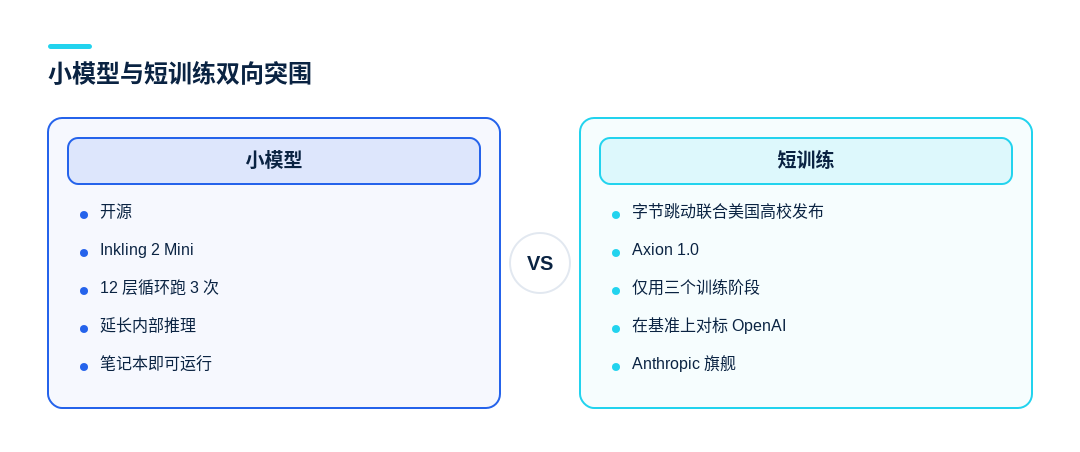
Thinking Machines open-sourced Inkling 2 Mini, which extends internal reasoning by 「running 12 layers three times」 and can run on a laptop. ByteDance and U.S. universities jointly released Axion 1.0, matching the flagship models of OpenAI and Anthropic on benchmarks after only three training stages. Both approaches point to the same conclusion: data and architecture quality are taking precedence over brute-force compute scaling.
Industry and Regulation: Valuation Pullback Reshapes Procurement
The Nasdaq 100 slipped into a bear market after its largest weekly decline since the pandemic. NVIDIA fell 14% over the week, while the SEC is reviewing its accounting practices. Anthropic nearly gave back all its gains the day after its record-setting IPO. A tighter financing environment is expected to pass through to vendor pricing and service terms, so enterprises should reassess supplier risk and plan for alternative supply options.
Today at a Glance
- Today's featured picks
- 6items
- Years the Riemann hypothesis remained unresolved
- 167years
- Claude proof's Lean formalization length
- 2510k pages
- NVIDIA's weekly decline
- 14%
Models and Products
OpenAI Releases GPT-6.2 Prompt Templates to Correct Model Behavior
OpenAI released new prompt templates for GPT-6.2 Astra and Sol to address three common model behaviors: overly brief responses, unnecessary follow-up questions, and excessive testing in coding tasks. The API has also been updated, including changes related to conversation editing. Official templates patch model behavior, indicating that these issues are already common in real-world use.
Model behavior still relies on prompt-level fallbacks, so enterprises should manage prompt templates as version-controlled operational assets. See AI Radar(/ai-radar/pricing)for the latest pricing and plan comparisons across providers.
Research Frontiers
Claude and Stanford Produce Separate Riemann Hypothesis Proofs on the Same Day
Anthropic mathematician Levent Alpöge announced that Claude had proved the Riemann hypothesis, which had remained unresolved for 167 years. The proof was formalized in Lean and spans more than 250,000 pages. Hours later, a Stanford team released an independent version produced entirely by humans. Latent Space covered the event that day as 「two independent proofs」; both conclusions await peer review by the academic community.
Model capabilities reaching the frontier of mathematics—and humans competing head-to-head the same day—make independent validation of AI outputs a prerequisite for adoption and compliance.
NVIDIA Research: Ultra-Long Contexts Are a Dead End; Retrieval Can Replace Them
NVIDIA researchers argue that language models often do not need the entire context window, and that ultra-long contexts are slow, expensive, and error-prone. Their alternative is periodic summarization combined with targeted keyword retrieval. Tests show that this method delivers results comparable to full-context processing in most cases.
Cost and architecture assumptions tied to ultra-long contexts need to be reassessed, making the retrieval-augmented approach worth watching.
Open-Source Ecosystem
Inkling 2 Mini Goes Open Source: Looped Architecture, Runs on Laptops
Thinking Machines released the open-source recurrent Transformer model Inkling 2 Mini. It reruns 12 of its 24 layers three times for each token, extending internal reasoning without generating more text, and can run on a laptop. It matched its peers in the Artificial Analysis Intelligence Index.
This looped architecture trades compute for additional generated tokens, providing a new open-source option for on-device deployment and low-cost inference. See AI Radar(/ai-radar/opensource)for further analysis of open-source projects.
ByteDance Releases Axion 1.0: Three-Stage Training Matches Flagship Models
ByteDance and several U.S. universities introduced the AI agent Axion 1.0. Trained in only three stages, it performs on par with leading commercial models from OpenAI and Anthropic in benchmark tests. The research team attributed its performance to carefully curated training data rather than adding more training stages.
Training cycles and costs could be significantly reduced, so data quality should take priority over the number of training stages when evaluating in-house model development or fine-tuning.
Industry and Regulation
Nasdaq 100 Enters Bear Market; NVIDIA Drops 14% in a Week
The Nasdaq 100 slipped into a bear market after its largest weekly decline since the pandemic. NVIDIA fell 14% over the week, and the U.S. Securities and Exchange Commission is reviewing its accounting practices. Anthropic nearly erased all its gains the day after its record-setting IPO. AI concerns, scandals, and other compounding factors weighed broadly on technology stocks.
The valuation downturn is expected to affect vendor pricing and service terms, so enterprises should reassess supplier risk and plan alternative supply options.
Follow Zhaoxun
Stay current with daily AI and Information Security developments. Contact us for help building your security capabilities.