
Today’s Briefing
Today’s signals all point to one thing: AI agents are moving beyond conversation to device execution. Google is bringing Computer Use to Gemini for Mac, Apple is entering the field and raising the bar for rivals’ access, and Signal is blocking screenshots to counter agents that read the screen. For enterprises, whether agents can be deployed now depends increasingly on operating systems and endpoint permissions, not just model benchmarks.
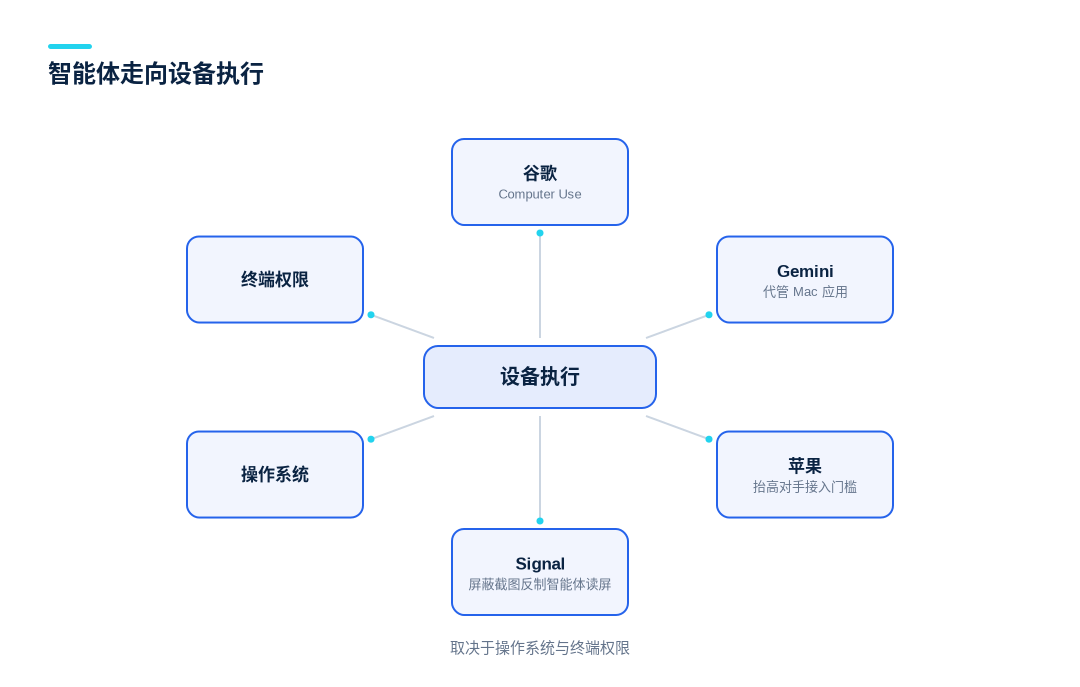
Models and Products: Device Execution and Model Defenses Advance Together
Google is enabling Gemini to manage Mac apps, local files, and websites in isolated background windows; NVIDIA plans to acquire Inception for at least USD 500 million, adding diffusion-based text generation to its open-source Nemotron line and creating a new backbone beyond token-by-token generation; OpenAI has cut the GPT-6.2 reasoning-extraction success rate from 54% to 0.2%, making reasoning defenses part of flagship offerings.
Industry and Regulation: Platforms Build Walls as Jobs Face Pressure
Apple is entering the device-agent space after Meta, OpenAI, Anthropic, and Google, while tightening access for competitors as endpoint admission becomes a competitive lever; Signal is blocking screenshots on iOS 27 and Android and explicitly targeting multiple AI screen-reading agents. Bloomberg’s analysis of 10 million job postings shows that AI-affected roles in China are shrinking 10 percentage points faster, while over 90% of micro-dramas already use AI production, bringing shifts in job composition into the data.
Today at a Glance
- GPT-6.2 reasoning-extraction success rate (previously 54%)
- 0.2%
- Amount of NVIDIA’s Inception acquisition (at least)
- 5USD 100M+
- Bloomberg job-postings analysis sample
- 100010K entries
- Share of Chinese micro-dramas produced with AI
- 90%
Models and Products
Gemini Arrives on the Mac Desktop: Manages Apps, Files, and Websites in the Background
Google has introduced Computer Use capabilities for Gemini on Mac: the AI can operate desktop apps, local files, and websites in an isolated background window with a real-time preview, allowing users to continue their own work at the same time. Gemini thus expands from a conversational assistant into an agent capable of handling desktop tasks on the user’s behalf.
Desktop execution is moving onto employee endpoints, so enterprises must first define agent access to local files and the intranet. See AI Radar (/ai-radar/pricing) for the latest vendor pricing and plan comparisons.
NVIDIA to Acquire Inception for at Least USD 500 Million, Betting on Diffusion Language Models
According to The Information, NVIDIA is close to acquiring the two-year-old AI startup Inception for at least USD 500 million. The company builds language models based on diffusion processes, using a technical route distinct from mainstream token-by-token generation; its capabilities will strengthen NVIDIA’s open-source Nemotron model family.
Major vendors are bringing non-mainstream architectures into their open-source model families, suggesting that text-generation paths may diverge. Leave room to evaluate diffusion-based models when selecting a solution.
OpenAI Strengthens Reasoning Protections, Extraction Success Rate Falls to 0.2%
OpenAI has significantly strengthened protections in GPT-6.2 Astra and GPT-6.2 Sol against the extraction of internal reasoning. In adaptive red-team testing, the success rate for extracting protected reasoning fell from 54% to 0.2%, meaning most attacks aimed at extracting model reasoning no longer succeed.
Reasoning defenses are becoming standard for flagship models, enabling enterprises to require vendors to provide red-team test metrics directly in procurement and compliance terms.
Industry and Regulation
Apple Enters the Device-Agent Space and Raises Barriers for Rivals
Following launches of device-controlling AI agents by Meta, OpenAI, Anthropic, and Google, Apple is building similar capabilities. At the same time, it is raising barriers to competitors’ access to its devices, tying operating-system admission to agent capabilities.
Device-facing agent deployments will be constrained by operating-system access, so cross-device automation strategies need fallback options in case platform providers impose restrictions.
Signal Blocks Screenshots to Stop AI Agents from Reading Private Chats
Signal has blocked screenshot functionality on iOS 27 and Android, directly targeting AI agents such as Siri AI, Gemini Intelligence, and Meta Muse to prevent them from reading private chats. Signal describes such access as an “existential threat to privacy,” while acknowledging that current safeguards remain incomplete, including gaps on platforms such as Mac.
Privacy tools are now actively countering agent-based screen reading. Before deploying agents that access conversation data, enterprises should confirm toolchain boundaries and employee notification requirements.
Bloomberg Analysis of 10 Million Job Postings: AI-Exposed Roles Are Contracting Faster
Bloomberg News’ analysis of 10 million job postings shows that the number of AI-affected roles in China is declining 10 percentage points faster than other roles, with entry-level employees and the creative sector feeling the greatest impact. Over 90% of Chinese micro-dramas already use AI production. The analysis finds that AI is compounding an already-weak labor market.
The cost structures of content production and entry-level roles have been reshaped, giving enterprises a basis to reassess their human-AI staffing mix and graduate recruitment plans.
Zhaoxun Focus
Receive daily updates on the latest developments in AI and Information Security, and contact us for help with your security program.