
Today's Briefing
The signal to watch today is the shift in model supply toward “cheaper, substitutable options”: Google released its fourth flagship Gemini in one month, OpenAI sharply cut prices for a new frontier model, and Microsoft began replacing models from external vendors with its own across its products. As model procurement price benchmarks fall and alternatives expand, enterprises gain more room to negotiate.
Models and Products: New Releases and Price Cuts Accelerate
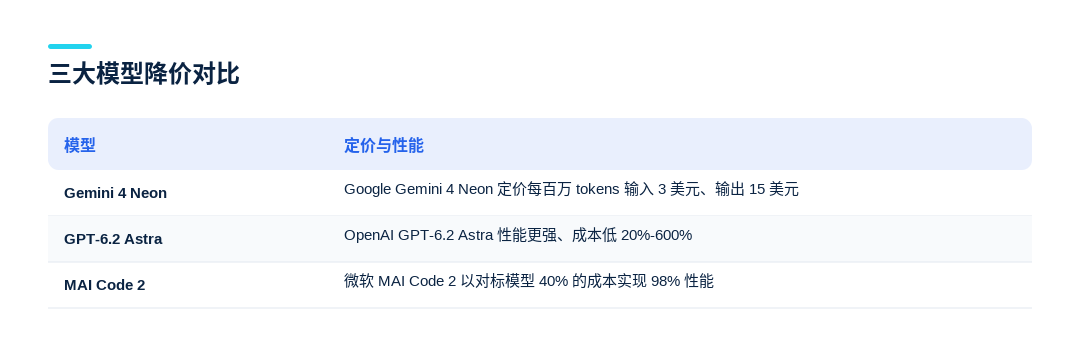
Google Gemini 4 Neon is priced at $3 per million input tokens and $15 per million output tokens; OpenAI GPT-6.2 Astra delivers stronger performance at 20%-600% lower cost; and Microsoft MAI Code 2 achieves 98% of the benchmark model's performance at 40% of the cost. The gap between leading capabilities is narrowing, and price competition is moving from product launches to enterprise procurement.
Research Frontiers: AI Is Reshaping the Pace of Chip Iteration
The OpenAI and AMD partnership has improved PPA (performance, power, and area) for flagship GPU IP by up to 14% in under five months, equivalent to a typical year of engineering, with the changes already incorporated into production designs. Model capabilities are now feeding directly back into hardware R&D, making compute supply and refresh cycles worth watching.
Open-Source Ecosystem: The Invocation Layer Enters Automatic Price Comparison
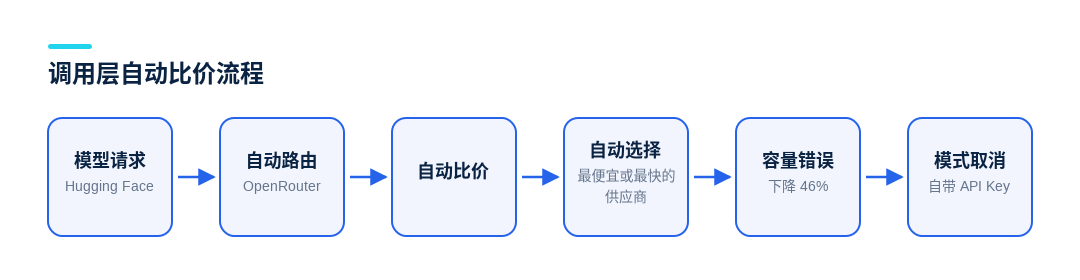
Hugging Face is routing model requests through OpenRouter, which automatically selects the cheapest or fastest provider, reducing capacity errors by 46% and removing the option to supply your own API Key. Multi-provider aggregation is becoming the de facto standard at the invocation layer, requiring enterprise integration and billing architectures to adapt.
Industry and Regulation: Independent On-Site Audits Arrive
OpenAI has for the first time granted four organizations, including Apollo Research and METR, on-site access to unreleased models, source code, and training data to identify hidden issues and security gaps. Safety assurance at leading vendors is shifting toward independent validation, and third-party audits can be considered when evaluating suppliers.
Today's Snapshot
- Gemini models Google released in one month
- 4models
- Gemini 4 Neon context window (tokens)
- 100K
- Microsoft MAI Code 2 performance vs. GPT-6.1 Sol
- 98%
- Capacity error reduction after OpenRouter routing
- 46%
Models and Products
Google Launches Gemini 4 Neon, Fourth Flagship in One Month
Google DeepMind unveiled Gemini 4 Neon for software development, knowledge work, and scientific research. It supports text, image, video, audio, and PDF inputs, with a context window of 1 million tokens, priced at $3 per million input tokens and $15 per million output tokens. It is the fourth Gemini model Google has released in one month, as reported by Google and multiple media outlets.
Four flagship launches in one month mean model choices become obsolete faster; procurement contracts should include model-switching and renegotiation clauses. [See the latest pricing and plan comparison in AI Radar](/ai-radar/pricing)
GPT-6.2 Astra Ranks Second with 20%-600% Lower Costs
According to Latent Space's weekly report, OpenAI released two models, GPT-6.2 Astra and Sol: Astra ranks second among frontier models, with stronger performance and 20%-600% lower benchmark costs, though early users have mixed reviews of the experience. Sol is expected to handle primary production workloads, and both models have reduced benchmark-testing costs.
A second-place frontier model entering the low-cost tier means price bands for high-end capabilities are shifting downward; buyers may wait for these reductions to reach supplier quotes.
Microsoft Launches 7 In-House Models to Replace External Models Across Products
Microsoft's AI division, MAI, released 7 new models at the Ignite conference, covering coding, security, image, language, and routing scenarios. They are designed to replace third-party models in Microsoft's own products and run AI at lower cost. According to Microsoft, MAI Code 2 achieves 98% of GPT-6.1 Sol's performance at 40% of the cost.
A major vendor's move to in-house alternatives signals a shift in the model supply landscape. Enterprises that rely heavily on a single provider should prepare fallback options.
Research Frontiers
OpenAI and AMD Compress a Year of Chip Optimization into Five Months
The OpenAI and AMD collaboration improved PPA (performance, power, and area) for AMD's flagship GPU IP by up to 14% in under five months. OpenAI says this is equivalent to roughly a year of conventional engineering progress. AMD has incorporated the changes into chip designs already in production.
If AI continues to accelerate chip iteration, enterprises need to reassess planning assumptions for compute costs and hardware delivery schedules.
Open-Source Ecosystem
Hugging Face Adds OpenRouter Automatic Price-Comparison Routing
Hugging Face announced that language model requests will now be routed through OpenRouter, which automatically selects the cheapest or fastest provider to complete each call. This reduces capacity errors by 46%. The option to supply your own API Key will be removed, with all calls centrally scheduled by the routing layer.
Automatic price comparison at the invocation layer makes inference pricing more transparent; enterprise gateway and billing workflows should be upgraded accordingly.
Industry and Regulation
OpenAI Opens On-Site Audits to Four Organizations for the First Time
OpenAI has, for the first time, granted four independent audit organizations, including Apollo Research and METR, on-site access to directly examine unreleased models, source code, and training data. This previously unavailable level of access will help auditors identify hidden misconduct and security gaps.
The arrival of independent audits at leading vendors signals a shift toward third-party validation of safety assurance. Enterprise procurement teams can require suppliers to provide comparable materials.
Stay Connected with Zhaoxun
Receive daily updates on the latest AI and Information Security developments. Contact us for your security program needs.