
Today's Overview
Supply pathways for agent models are diverging: Meituan's open-source 1.6-trillion-parameter model was trained entirely without NVIDIA GPUs and nearly matches Claude Opus 5 on benchmarks; leading vendor Anthropic has shifted image generation toward code execution. On the same day, the transparency of intermediary channels for NVIDIA's China orders was questioned, while the Reserve Bank of Australia confirmed that entry-level hiring and employment have been depressed. As the range of model options expands amid greater supply-chain and talent uncertainty, enterprises need to reassess procurement and workforce planning together.
Models and Products: Image Generation Takes a Code-Based Route
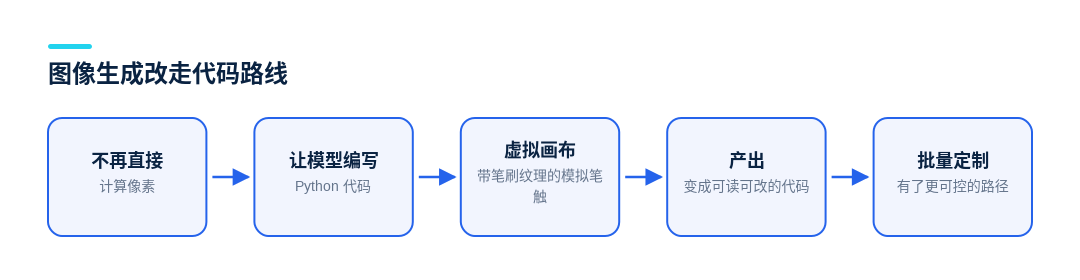
Anthropic's Claude Fable 5.2 no longer computes pixels directly. Instead, it writes Python code that places hundreds of thousands of simulated brushstrokes with brush-texture detail on a virtual canvas. The output shifts from a black-box image to readable, editable code, offering a more controllable way to mass-customize marketing and design content.
Open-Source Ecosystem: Open Agents Close in on the Proprietary Frontier
Meituan has open-sourced the LongCat-2.5 weights: 1.6 trillion parameters, built for agent tasks, and trained without NVIDIA GPUs. It scores 88.4 on Terminal Bench, closely behind Claude Opus 5, while the reference deployment requires just 194 Huawei chips. Non-NVIDIA compute can now train and deploy agent models approaching proprietary performance, expanding private-deployment options for enterprises.
Industry and Regulation: Order Transparency and Job Displacement Coexist
According to The Wall Street Journal, a company associated with NVIDIA's former CEO Jensen Huang brokered nearly $12 billion in China-bound chip orders in 2024–2025, while short sellers questioned the actual scale; the Reserve Bank of Australia observed declines in recruitment and employment among 15–24-year-olds in software development and customer service roles. Compute procurement channels and entry-level talent supply should both be added to risk registers.
Today's Highlights
- Meituan's open-source agent model parameter count
- 1.6trillion
- LongCat-2.5 Terminal Bench score
- 88.4points
- Huawei chips for the reference deployment
- 194chips
- NVIDIA China-bound orders brokered, 2024–2025
- 120billion USD
Models and Products
Claude Fable 5.2 Paints with Code and Hundreds of Thousands of Simulated Strokes
Anthropic's Claude Fable 5.2 generates images differently from other models: instead of computing pixels directly, it writes Python code that places hundreds of thousands of simulated brushstrokes on a virtual canvas and reproduces details such as brush texture. Image output therefore shifts from black-box pixels to readable, editable code, and generation moves from model inference to programmatic control.
Code-based generation makes brand visual content reviewable and easy to fine-tune at scale; marketing and design teams are likely to pilot it first. Compare providers' latest pricing and plans in AI Radar (/ai-radar/pricing).
Open-Source Ecosystem
Meituan Open-Sources a 1.6-Trillion-Parameter Agent Model Trained Without NVIDIA
Meituan released LongCat-2.5 and open-sourced the model weights: 1.6 trillion parameters, built for agent tasks, and trained entirely without NVIDIA GPUs. The model scores 88.4 on the Terminal Bench benchmark, closely behind Claude Opus 5, and the official reference deployment uses 194 Huawei chips. This case shows that non-NVIDIA compute can support the training and deployment of trillion-parameter agent models.
As open-source agent models approach proprietary frontier performance, enterprises can evaluate and privately deploy agent capabilities at lower cost; explore more open-source projects in AI Radar (/ai-radar/opensource).
Industry and Regulation
Affiliated Company Brokered Nearly $12 Billion in NVIDIA China-Bound Chip Orders
According to The Wall Street Journal, Megaspeed, a company controlled by Alice Huang—the former partner of NVIDIA's former CEO Jensen Huang—brokered nearly $12 billion in NVIDIA chip orders for Chinese companies in 2024–2025. Short seller Culper Research has a different estimate of NVIDIA's actual China-bound sales, putting the true scale and channels of these orders under scrutiny.
China-bound orders brokered by affiliated third parties mean enterprises reliant on NVIDIA compute need to reassess compliance and supply-continuity risks across procurement channels.
Reserve Bank of Australia: AI Impact Depresses Entry-Level Software and Support Roles First
The Reserve Bank of Australia has observed early signs of AI's employment impact: since ChatGPT launched, job postings and employment among people aged 15 to 24 have declined in roles most exposed to AI, such as software development and customer service. Drawn from central bank data, this finding indicates that AI's displacement of entry-level execution roles is now visible in official statistics.
Contraction in entry-level roles could create gaps in the talent pipeline, so recruitment and training plans need to factor in AI's impact ahead of time.
AI Day Seoul: Over 2000 Attendees Focus on Physical AI and Agents
NVIDIA held the two-day AI Day Seoul at COEX in Seoul, drawing over 2000 participants from Korean industry, startups, and the developer community. Topics centered on physical AI and AI agents, with NVIDIA robotics business vice president Deepu Talla addressing the plenary session. South Korean industry is accelerating its strategy around both priorities.
South Korean industry and NVIDIA are backing physical AI and agents, with potential spillover effects for Asian manufacturing and robotics supply chains worth watching.
Stay Connected with Zhaoxun
Get daily updates on the latest AI and Information Security developments. Contact us with your security program build-out needs.