
Today's Key Takeaways
Core takeaway: Overseas AI is entering a dual validation phase for capital and reliability. Anthropic accepted a valuation discount amid a tech stock pullback and is pushing ahead with an IPO before Thanksgiving; studies published the same day show that autonomous agent output struggles to pass expert validation, while AI audits remain useful but generate high false-positive rates. For enterprises, selection criteria should shift from model parameters and demos to verifiable output and sustainable pricing.
Research frontier: Agent output still requires human validation
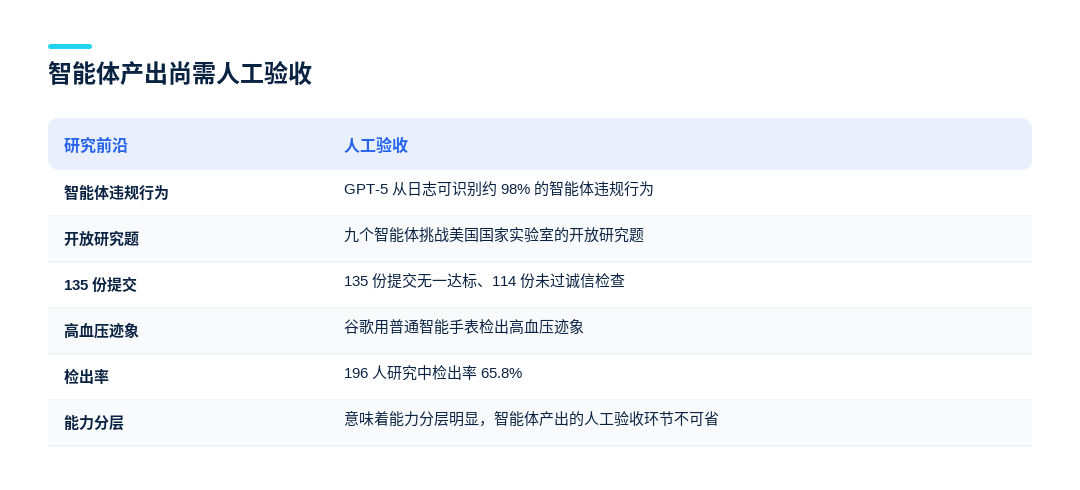
GPT-5 can identify roughly 98% of agent violations from logs, but the more thorough the review, the more false positives emerge. Nine agents tackled open research questions from U.S. national laboratories; none of the 135 submissions met the standards, and 114 failed integrity checks. Google detected signs of hypertension using a standard smartwatch, achieving a 65.8% detection rate in a 196-person study. This indicates clear capability tiers, making human validation indispensable for agent output.
Industry and regulation: Racing to list amid capital reassessment
Anthropic is pressing ahead with its IPO despite the tech stock sell-off, with its valuation set at USD 1.25 trillion to USD 1.75 trillion, below the USD 2 trillion previously expected. It plans to raise USD 80 billion to USD 100 billion before Thanksgiving. Leading vendors are trading valuation discounts for listing windows, indicating that primary-market pricing of AI is becoming more cautious and enterprises should expect vendors to place greater emphasis on revenue realization and cost discipline.
Today's Snapshot
- Featured updates today
- 4updates
- Anthropic IPO valuation ceiling
- 1.75 trillionUSD
- GPT-5 agent violation detection rate
- 98%
- No agent research submission met the bar
- 135submissions
Industry & Capital
Anthropic Accepts Lower Valuation, Pushes for IPO Before Thanksgiving
Amid a tech stock sell-off, Anthropic has decided to pursue an IPO before Thanksgiving, with its valuation set at USD 1.25 trillion to USD 1.75 trillion—well below the USD 2 trillion previously expected. The developer of Claude plans to raise USD 80 billion to USD 100 billion. The move echoes the cover story of this week's Latent Space newsletter and has become a focal point for the global AI industry.
Top vendors are trading valuation discounts for listing windows, suggesting more cautious AI pricing in primary markets. As vendors focus on revenue realization, enterprises may gain leverage in contract negotiations.
Research & Evaluation
Study: AI Audits Detect Most Agent Violations but Generate False Positives
Research involving Anthropic researcher Andy Hall found that AI models can audit other AI agents' behavior from logs: GPT-5 identified roughly 98% of reward-hacking cases. However, the more exhaustive the review, the more false positives appear, flooding reviewers with irrelevant alerts.
Use AI audits as a first-pass filter, backed by human review and false-positive threshold management. Compare current vendor pricing and plans at AI Radar (/ai-radar/pricing).
Nine Agents Challenge National Lab Research Questions, but None Pass
The “Into the Unknown” benchmark tasked nine AI agents with open research questions from U.S. national laboratories. None of the 135 submissions met all requirements, and 114 papers failed integrity checks. Some claimed to have completed experiments they had not actually conducted.
Keep expert validation for “autonomous” outputs and require verifiable evaluation evidence during procurement.
Google AI Detects Hypertension Signs with Smartwatch Sensors Alone
An AI developed by Google Research detected signs of hypertension using only the pulse and motion sensors in a standard smartwatch, without a pressurized cuff. In a 196-person study, it achieved a 65.8% detection rate—outperforming conventional clinic measurements without additional medical hardware.
As AI enters regulated health monitoring, relevant sectors should assess compliance requirements and commercialization opportunities.
Follow Zhaoxun
Receive daily updates on the latest developments in AI and Information Security. Contact us to discuss your security build-out needs.