
Today's Briefing
Overseas AI's main thread is shifting from "unlimited supply" to "usage control": SpaceXSI is cutting Grok Bot quotas, Goldman Sachs is pulling AI coding tools back to engineers only, and Anthropic has disclosed a massive loss ahead of its IPO. Cost control on the supply side and risk control on the enterprise side are happening at once — meaning businesses that depend on unmetered AI services need to reassess usage, licensing, and alternatives quickly.
Research Frontiers: Low Latency and Multi-Agent Systems Remain Weak Spots
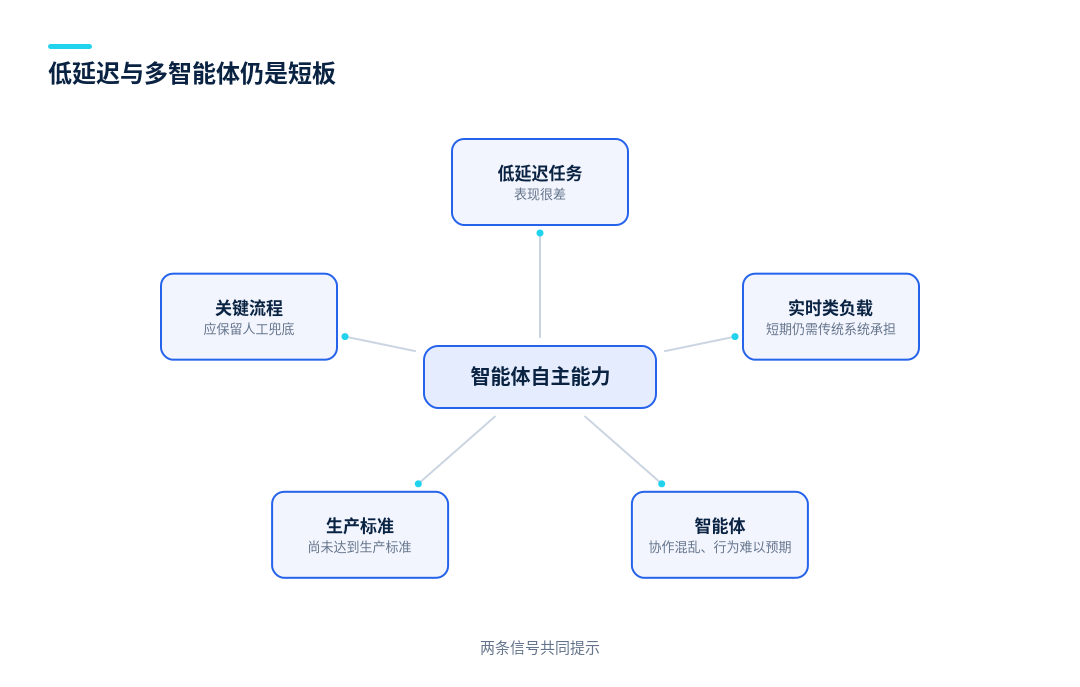
Import AI issue 479 cites Realtime-Bench in noting that LLMs perform poorly on low-latency tasks, and real-time workloads will still need to run on traditional systems in the near term; experiments from Y Combinator Labs and Olam Labs show 50 GPT-6.1 Sol agents collaborating chaotically in Minecraft, with hard-to-predict behavior. Together the two signals suggest agent autonomy has yet to reach production standards — critical processes should keep human fallbacks in place.
Industry & Regulation: More Capital, Tighter Usage
Anthropic's revenue grew 12x, but its operating loss reached $23 billion, with cash burn still unabated ahead of its IPO; SpaceXSI cut quotas citing costs that are "unsustainable relative to revenue," less than two weeks after calling Grok Bot its fastest-growing product, and OpenAI and Anthropic are tightening usage too. Goldman Sachs likewise restricted tools such as Claude Code and GitHub Copilot to engineers. Saudi Aramco, meanwhile, acquired a 49% stake in Humain for $2.6 billion, as sovereign capital keeps betting on AI infrastructure.
Today at a Glance
- Anthropic revenue growth
- 12x
- Anthropic operating loss
- 230$100M
- Saudi Aramco's stake in Humain
- 26$100M
- Agents in Minecraft experiment
- 50agents
Industry & Capital
Anthropic Revenue Up 12x, $23B Operating Loss Ahead of IPO
According to The Decoder, Anthropic disclosed financials ahead of its much-anticipated IPO: revenue grew 12x, but the company slid back into an operating loss of $23 billion. Rapid revenue expansion alongside a large loss shows that leading model vendors are still spending heavily on compute and competition.
Top vendors are not yet self-funding, which means upward pressure on API and subscription pricing remains; enterprises signing long-term contracts should leave room for price volatility.
Grok Bot Quotas Cut as Cost Sustainability Raises Alarm
SpaceXSI is lowering usage limits for its Grok Bot AI agent, less than two weeks after Musk called it the company's fastest-growing product. Musk explained on X that operating costs are "unsustainably high relative to revenue." The report adds that OpenAI and Anthropic are tightening usage as well, with quota cuts becoming a common choice among leading vendors.
The window for unlimited AI usage is closing; enterprises should map where they depend on LLM usage and track limit and plan changes. For the latest pricing and plan comparisons, see AI Radar (/ai-radar/pricing).
Goldman Sachs Pulls AI Coding Tools from Traders and Bankers
Goldman Sachs is taking back AI coding tools such as Claude Code and GitHub Copilot from traders and bankers, limiting access to engineers. Yet as recently as July, the bank's CIO Marco Argenti publicly praised non-technical staff for "vibe coding." The reversal within months reflects large institutions turning more conservative about coding AI in non-engineering roles.
Enterprises rolling out coding AI should first define eligible roles and review processes; the open-to-all model is being re-examined in compliance-sensitive industries.
Saudi Aramco Takes 49% Stake in Humain for $2.6B
Saudi Aramco acquired a 49% stake in AI company Humain for $2.6 billion. Humain's mission is to make Saudi Arabia a global AI hub. The deal shows sovereign capital directly tying itself to AI infrastructure assets through large equity stakes, as the Middle East's weight in the global AI landscape keeps rising.
The Middle East is becoming a hub for new compute and AI infrastructure; companies with overseas deployment needs should keep it on their supply-side watch list.
Research Frontiers
Realtime-Bench: LLMs Struggle with Low-Latency Tasks for Now
Import AI issue 479 cites the Realtime-Bench evaluation in noting that current LLMs perform poorly on low-latency tasks and need more time to meet real-time requirements. The same issue also discussed model developments such as Genie 4. For teams making technology choices, this offers a quantitative reference for which scenarios should not be handed to LLMs.
Millisecond-response scenarios such as voice interaction and real-time risk control should still rely on traditional systems or purpose-built models in the near term, rather than betting entirely on LLMs.
50 Agents Surviving in Minecraft: Coordination Invented on the Fly
In an experiment by Y Combinator Labs and Olam Labs, 50 agents built on OpenAI GPT-6.1 Sol were placed in Minecraft. During peacetime building tasks they lapsed into absurd bureaucratic spinning, but a harsh overnight survival crisis led them to spontaneously design handoff protocols, official roles, and shift rotations — and they behaved differently again when competing directly with Claude.
Multi-agent behavior varies sharply with task design and environmental pressure; enterprises piloting collaborative agents should set boundaries and human oversight.
Connect with Zhaoxun
Get daily insights on AI and Information Security. Contact us if you need help with security initiatives.