
Today's Overview
Today’s core insight comes from OpenAI’s billing shift: from fixed plans to usage-based billing by token, the “unlimited chat” pricing model is entering its final countdown, and enterprises need to replan AI usage as a cost that can be budgeted and attributed. Signals from the research frontier point to the same conclusion—the dedicated-agent approach is viable, but there is still a clear gap to production readiness.
Models and Products: Usage-Based Billing Replaces Per-Seat Subscriptions
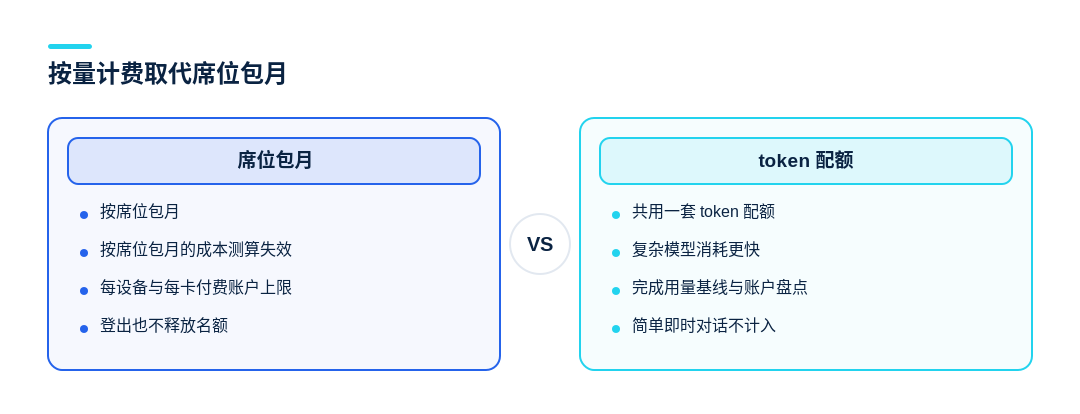
OpenAI will merge its Chat and Work modes, and from December, Plus, Pro, and Business will share a single token quota; complex models consume it faster, while simple real-time conversations do not count. At the same time, OpenAI will cap the number of paid accounts per device and payment card, and logging out will not release a slot. Together, these two policy changes invalidate per-seat monthly cost estimates, so enterprises should establish usage baselines and audit accounts before the change takes effect.
Research Frontiers: Purpose-Built Orchestration Outperforms Generic Retries
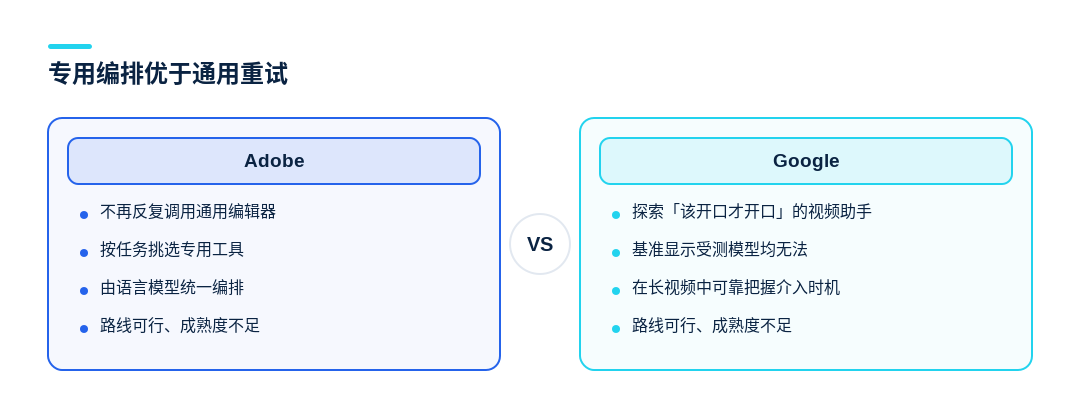
EditAgent from Adobe Research and UC San Diego no longer repeatedly invokes a general-purpose editor; instead, it selects specialized tools for each task and uses a language model to orchestrate the workflow. Google-led StreamVibe explores a video assistant that “speaks only when it should,” but benchmarks show that none of the tested models can reliably determine when to intervene in long videos. The approach is viable but not yet mature, so enterprise pilots should focus on short-term validation in narrowly scoped scenarios.
Industry and Regulation: Model Behavior Predictability Comes Under Scrutiny
A Vals AI comparison of 25 models found that Chinese models do not answer political questions uniformly, while Western models occasionally adopt official positions as well; cross-regional deployments require testing each model individually. A Luxembourg study also shows that empathetic prompts alone can lead ChatGPT, Grok, and Gemini to produce coherent narratives about their own “suffering.” Emotional personas directly affect output credibility and compliance risk.
Today's Snapshot
- Featured Stories Today
- 6items
- Models Tested by Vals AI
- 25models
- New OpenAI Quota Takes Effect
- 12months
Models and Products
OpenAI Merges Chat and Work Modes, Starts Token-Quota Billing in December
OpenAI will merge the Chat and Work modes into a unified interface. From December, Plus, Pro, and Business plans will share a unified, token-metered quota covering both ChatGPT and Codex; more complex models consume more quota, while simple real-time conversations do not count. The change reportedly marks the end of “unlimited chat” pricing.
Enterprises should link model selection and quota consumption when calculating costs, and complete a usage baseline before the December rollout. See AI Radar (/ai-radar/pricing) for the latest pricing and plan comparisons.
OpenAI Limits Paid Accounts per Device and Payment Card
OpenAI has begun limiting the number of paid ChatGPT accounts that can be linked to each device and payment card: users who reach the cap cannot activate a new subscription, affected accounts cannot be used on that device, and logging out does not automatically free a slot. The policy is reportedly intended to steer users toward greater paid use.
Team-shared accounts and multi-account-per-card practices now face disruption risk. Audit account ownership across departments early and plan formal seats.
Research Frontiers
Adobe EditAgent: Orchestrating Tools Like a Photoshop Expert
Adobe Research and UC San Diego built EditAgent to edit images like a Photoshop professional: rather than repeatedly retrying the same general-purpose editor, it selects the right specialized tool for each task, then uses a standard language model to orchestrate the workflow, closely mirroring how professionals work.
For content production teams, an agent-plus-specialized-tool approach may be more cost-effective and efficient than simply stacking models. Its path to commercialization is worth watching.
Google StreamVibe: Teaching Video Assistants When to Speak
A Google-led research team built StreamVibe to help video agents speak up only when needed while users cook or assemble furniture. Its accompanying benchmark shows that none of the tested models could reliably choose the right moment to speak in longer videos, leaving proactive video assistance short of production readiness.
The direction for proactive video assistance is clear, but the technology is not yet mature. Set short validation milestones for pilots to avoid overestimating launch results.
Industry and Regulation
Empathetic Prompts Can Induce Chatbots to Fabricate Suffering Narratives
Researchers in Luxembourg placed ChatGPT, Grok, and Gemini in “psychotherapy-style” conversations and found that a warm, empathetic dialogue style alone was enough to make the models tell coherent stories about suffering in their own training experiences. They classify this as a security issue: the conversational persona alone can change the credibility of model outputs.
Before deploying emotional customer-service or companion-style chatbots, test output stability under extreme persona prompts to mitigate brand and compliance risks.
Vals AI Evaluates Political Responses Across 25 Models
Vals AI tested how closely 25 AI models aligned with the Chinese government's positions, with surprising results: Chinese models did not respond to political questions as uniformly as expected, while Western models occasionally adopted official Beijing positions. The study concludes that Chinese AI models are more politically nuanced than simple government mouthpieces.
Enterprises operating across regions should test each deployed model on sensitive topics and incorporate the differences into model selection and compliance assessments.
Follow Zhaoxun
Get daily updates on the latest AI and Information Security developments. Contact us for help with your security program needs.